Ecstatic return to the Theatre of Orgies and Mysteries, Nitsch's last festival
Nitsch Foundation organised a revival of the last days of the extreme work '6-Tage-Spiel'

6' min read
6' min read
In the Austrian town of Prinzerdorf an der Zaya, fifty minutes from Vienna, words are heard in all European languages. But above them all, a single timbre rises up, dramatic, intense, roaring: the organ of Hermann Nitsch, who, who passed away on 18 April 2022, is as alive as ever in the looks and breaths of those gathered.
From all over the world, passionate, curious, enthusiastic people gathered, moved by the desire to break out of the post-bourgeois and algorithmic routine of the contemporary workshop-world to access a truer, more authentic, spring-like experience, the one that artist Hermann Nitsch synthesised in his Orgies and Mysteries Theatre (Orgien Mysterien Theater - OMT, in shareholder jargon).
Nitsch Foundation
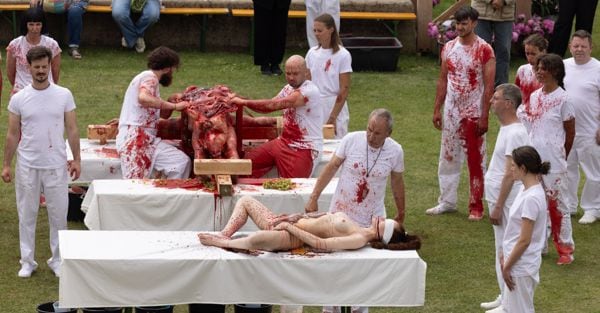
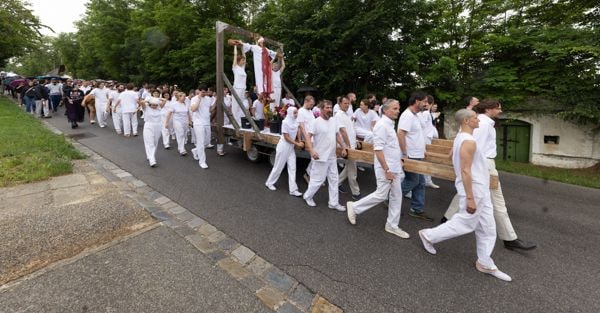
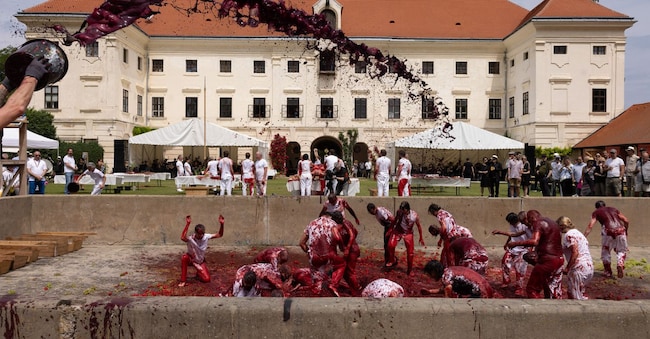
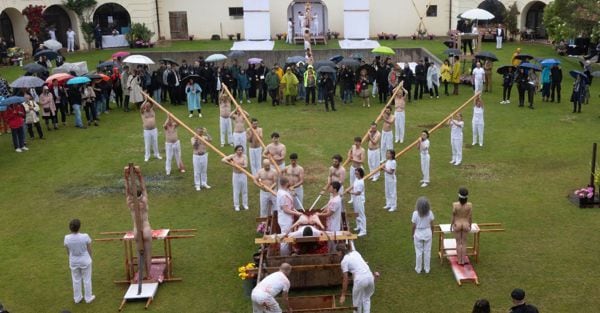
From 7 to 9 June 2025, in fact, the Nitsch Foundation, animated by the indefatigable energy and stubborn vitality of his widow Rita, has organised a repetition of the last days of Nitsch's extreme work, the '6-Tage-Spiel', the six-day continuous performance that the artist managed to organise in its entirety only once during his lifetime, in 1998 (from 3 to 9 August to be precise). For organisational and financial reasons, the Foundation decided to break up the mammoth work, destined to be Nitsch's last action, No. 160: the first two days took place in June 2022, the third in May 2023, and today the work finds its completion.
In it, the controversial Austrian artist, a leading exponent of Viennese Actionism and the 'black beast' of petty-bourgeois and puritanical conservatism, hybridised his greatest passions - theatre, music and action painting. The result: a unique synaesthetic work, capable of realising the Wagnerian dream of the 'total work of art' (Gesamtkunstwerk) in a gory version, with extensive use of dismembered animal bodies. The OMT blends multiple aesthetic and philosophical inspirations, drawn from heterogeneous sources: in it we find the magisteriums of the aforementioned Richard Wagner, Friedrich Nietzsche, Martin Heidegger, Stefan George, as well as images from Greek tragedy and Christian iconography, the hierophanies of myth, and the insights of the artistic avant-gardes of the 20th century. And all these fragmentary images become One in Nitsch's Philosophy of Being.
An orchestra of some ninety members
.The fil rouge around which all these themes become art is music. An orchestra of some ninety members dialogues with Nitsch's organ music, which some speakers in the Prinzerdorf garden make resound incessantly throughout the three days. Occasionally, drums, gongs, bells make their entrance. Andrea Cusumano, the conductor, a pupil and friend of Nitsch, masterfully directs the orchestra from an elevated podium, with its minimalist motifs - mostly clusters - and sometimes apocalyptic tension effects.