
Ed Freeman: 'Capitalism 2.0? It has to start with its five stakeholders"
The theory on which the ESG revolution is based turns 40 and the guru celebrated the special anniversary in Italy

3' min read
3' min read
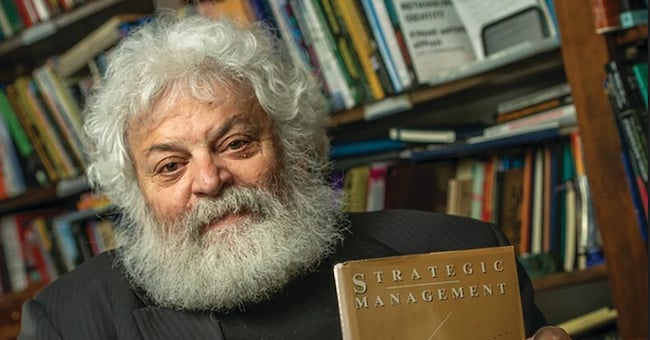
The future of capitalism is 40 years old (and counting). Only in appearance is this a paradox. In reality, the desired reform of capitalism in a more ethical and social sense - much discussed at the UN and at all sustainability events - was already described in 1984, in the book 'Strategic management: a stakeholder approach' written by Ed Freeman.
Forty years later, the dictates of the prophet of ethical business build the basis of the ESG revolution (the environmental, social and governance criteria required to do business). They seem obvious now, and you only have to leaf through a sustainability report to read about the importance of all stakeholders on almost every page. But until 1984, the vocabulary of ethical business did not even exist: the philosopher Freeman created and described it, daring to refute the prevailing shareholder theory of the cynic Milton Friedman, according to which the ultimate aim of business is to make profits, while respecting the rules (and that's all). Today, Freeman is perhaps the most cited economist in the world, in terms of number and relevance of citations in scientific publications, despite not being an economist by training. And no one would be surprised (apart from himself, in his candid understatement) if he won the Nobel Prize in economics. The revered ethical business pioneer is now professor emeritus at the Darden School of business (University of Virginia), as well as the author of 32 books and countless scientific papers, successful podcasts and even songs (he plays and composes songs with his college rock band Blues Jam). But he maintains a humble approach that baffles and captivates his listeners. Like the participants of the recent conference in the 17th-century monumental complex of Sant'Ivo alla Sapienza (home of the State Archives in Rome), organised by the Gbs (Gruppo bilanci e sostenibilità) with the support of the National Council of Chartered Accountants and Accounting Experts. Freeman enthusiastically accepted the invitation to Italy of his fellow academics presenting a position paper entitled 'Value and Sustainability. Ideas for a discussion in companies'.
The lectio magistralis
Freeman's keynote lecture was characterised by a strong optimism towards the ethical turn of the best companies. "By now the business world has well understood that purpose, even ethical purpose, is as important as profit for investors, and indeed multiplies it because business and ethics are interconnected," he explained. "It is now universally believed that shareholders are only one of the five stakeholder groups, the stakeholders, to which companies must refer. The other four groups are workers, customers, suppliers and the community as a whole: their demands must be taken on board and criticisms analysed, also because they can constitute business leverage'.
The power of dialogue
.Freeman acknowledges that holding all stakeholders accountable is a complex operation, but he believes that only through dialogue with all parties can solutions to the many problems created by mankind on the planet, from global warming to vast economic and social disparities, emerge. "We all like to probe problems in depth, but this is of no use if solutions are not proposed," he explained. "And since social and economic systems are interconnected, it is through the collaboration of all stakeholders that the most creative solutions, inspired by art, music, philosophy, can emerge. The task of business and governments, then, is to listen to their communities. "There are many invisible people in the world, who demand to be heard and held to account, and social entrepreneurship now considers them key stakeholders,' Freeman added. 'Giving a purpose, a clear ideal inspiration to the company and its workers, is now an established priority, not only ethically but economically. Purpose serves the business like red blood cells are needed by the human organism: we never think about it, but you cannot live without it'. Finally, Freeman justified his optimism towards the future of the economic ecosystem. 'Progress is steady and positive,' he concluded. 'Forty years ago, businessmen laughed when I told them this vision, then they had to reconsider and today they are the biggest supporters. Because this is the scenario underlying the future of capitalism, which I still believe is the best way to manage and grow economic systems'.


