
Edoardo Prati transforms Gozzano's poetry into a tale of the present
The creator rereads 'Le golose' by the Turin poet and shows how desire, consumption and the pursuit of happiness still speak to contemporary society

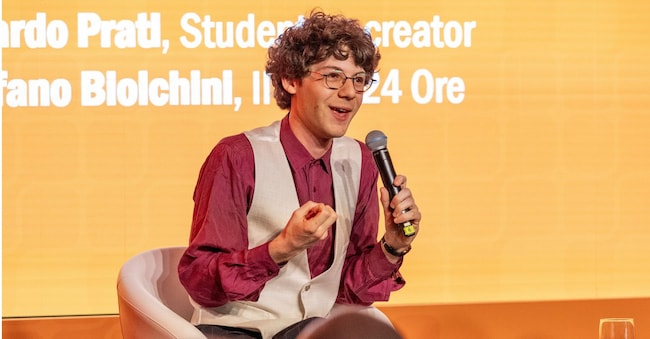
An early 20th century poem, a pastry shop full of elegant girls, the scent of chocolate and pastries. It is in this atmosphere suspended between literature and contemporaneity that Edoardo Prati's monologue dedicated to Guido Gozzano's Le golose takes place as part of the Fuori Festival dell'Economia. Born in 2004, a student of Classical Literature at the University of Bologna and a very popular face on social networks, Prati has built an audience thanks to his ability to bring literature back to the present, removing it from the exclusively scholastic and academic dimension. He does not merely explain texts: he traverses them, interprets them and translates them into a language close to contemporary sensibilities, making them accessible especially to the young. And that is precisely what happens with The Gourmands, where the influencer re-proposes verses written more than a century ago to an audience of children.
The figure of young women
The young women recounted by Gozzano, sitting in a pastry shop amidst sweets, conversation and small worldly rituals, are no longer distant figures, but become immediately recognisable. Behind their bourgeois lightness that tries to imitate aristocracy in gestures and manners, desires, fragility, the need to appear and the search for happiness emerge. All dynamics that still belong to the present. Prati's monologue thus manages to transform a crepuscular poem into a topical reflection on consumption and social identity. Gozzano's melancholic irony is treated with delicacy, without ever being trivialised. At the heart of the reading is above all the modernity of the Turinese poet's gaze: a society that seeks happiness in petty consumption and social rituals is not so different from that of today, where desire continues to define relationships, behaviour and forms of recognition. The pastry shop described by Gozzano thus becomes a symbolic space in which people meet, observe each other and build an image of themselves.
Always up-to-date content
Epochs, languages and places change, today perhaps replaced by social networks or digital spaces, but the tension towards an immediate, fragile and continuously exhibited happiness remains identical. The 'gluttons' thus end up resembling contemporary consumers, immersed in a society that transforms desires and needs into experiences to be lived and displayed. It is precisely here that the strength of Prati's work emerges. Starting from authors who are often perceived as distant - not only Gozzano, but also Dante Alighieri, Eugenio Montale, Giacomo Leopardi, Giovanni Pascoli and Giuseppe Ungaretti - the populariser succeeds in showing their topicality through simple but never superficial language. Literature thus loses its austere tone to become a living, emotional and everyday experience.
Poetry belongs to the present
The monologue, at the end, leaves a definite feeling: poetry does not belong to the past. Instead, it continues to speak of the present, of its desires and anxieties. And perhaps this is precisely why he manages to fill a hall with young people ready to listen to his words so full of love for literature. The finale - for this popular meeting among the young and not only - was thunderous with applause: confirming that talking about beauty warmed and still warms hearts and minds.


