A successful initiative

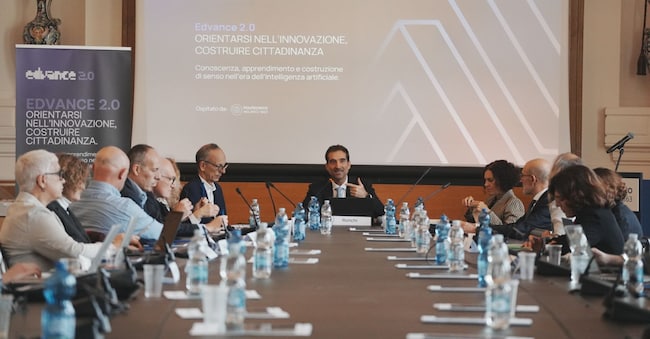
Edvance 2.0: the next phase of the Advanced Digital Culture hub was unveiled at the Politecnico di Milano

Now that the phase funded by the NRRP has come to an end, the network of 16 universities and higher education institutions for the arts, coordinated by the Politecnico di Milano, is continuing and expanding: the courses remain free of charge and open to students, lecturers, professionals and members of the public

4' min read

Translated by AI
Versione italiana

4' min read

Translated by AI
Versione italiana

Over 150,000 students and professionals trained, over 360 free courses open to all, and over 530 CFU credits awarded: these are some of the figures presented today in the Aula Magna at the Politecnico di Milano to highlight the success of Edvance, the national network for Advanced Digital Culture coordinated by the Politecnico di Milano through METID, the university body that has been working on educational innovation and technologies to support learning for the past thirty years.

Italia’s first Digital Education Hub

Established as part of the National Recovery and Resilience Plan and with funding from the European Union — NextGenerationEU — Edvance has been designed to be Italia’s first Digital Education Hub dedicated to Advanced Digital Culture: 16 universities and higher education institutions in the arts and music sector have come together under the coordination of the Politecnico di Milano to make digital training — particularly that relating to the informed and responsible use of artificial intelligence — simpler and accessible to all via a free online platform.

Loading...

Connecting universities and local communities

Edvance thus presents itself as a civic infrastructure that connects universities and local communities, offering people the knowledge and tools to understand digital transformations, exercise their rights and participate critically and informedly in social life in the age of AI.

Edvance 2.0

The event also provided an opportunity to launch the new phase, known as Edvance 2.0. Whilst the phase funded by the PNRR has now come to an end, the project’s great success has led the organisers to decide to open a new chapter. Edvance 2.0 aims to build on the work carried out over the last two years, the skills developed and the relationships forged between partner institutions, by making content and tools available to those outside the university who train and support people: schools, local authorities and third-sector organisations.

Shared capabilities

The project has already resulted in shared capabilities across institutions: a single portal that brings together the universities’ MOOCs, accessible using university credentials, SPID or CIE; common guidelines and criteria for designing courses and monitoring their quality; an Open Badge and micro-credential system that documents the skills acquired and, where institutions so provide, recognises them within learning pathways; training activities for lecturers and pilot schemes on the use of artificial intelligence in teaching.

Success

“Edvance’s success lies not only in the figures, but in the fact that sixteen institutions have learnt to collaborate on the design of interoperable platforms and training programmes in advanced digital skills, based on common quality standards. We have provided the country with an infrastructure that represents an asset to be harnessed, particularly in the fields of artificial intelligence, data and digital sustainability,” said Donatella Sciuto, Rector of the Politecnico di Milano. “For our university, coordinating this project has meant acting as a hub within a network that forms a cohesive system. This is the direction we must take to tackle a challenge that requires far more than the sum of individual areas of excellence. I am therefore delighted that the Edvance initiative can continue into a second phase.”

Satisfaction

Our determination to continue stems from the realisation that we have built up a valuable and essential asset in a country such as Italia, where, as highlighted in the European Commission’s National Report on the Digital Decade 2026, only 54.27 per cent of people aged between 16 and 74 possess basic digital skills, which is below the EU average of 60.4 per cent. The high level of satisfaction among those who attended the organised courses also confirms the success of the project: participants rated their satisfaction at over 4 on a Likert scale of 1 to 5.

AI literacy and training

The continuation of Edvance is also in line with the need to promote literacy and training in artificial intelligence, as also set out in Legislative Decree No. 179 of 7 October 2026, which brings national legislation into line with the European Regulation on artificial intelligence. Having come into force on 23 October, the decree provides, amongst other things, for training activities to promote understanding of AI systems and their safe and informed use. With Edvance 2.0, the network aims to contribute to this need by making courses and skills accessible to a wide audience.

Cross-cutting requirement

During the event, a panel discussion was held on ‘Education in the age of artificial intelligence: knowledge, meaning and responsibility’, featuring Claudia Paganini, philosopher and theologian at the University of Innsbruck, and Massimo Chiriatti, technologist and founder of Metatecnica, moderated by Susanna Sancassani, Project Manager at Rete Edvance and Managing Director of METID. “Education is becoming a necessity that cuts across all ages, professions and the roles we each play in the world. The transformations currently taking place do not merely concern the professional sphere, but also our daily lives and the exercise of our rights as citizens. For this reason, training must be seen as a lifelong necessity for individuals, and will need to become increasingly integrated with the processes we experience every day,” commented Federico Caniato, Professor of Business Management and Organisation and Delegate for Continuing Education at the Politecnico di Milano.
Edvance courses remain free of charge and can be accessed via the network portal using university credentials, SPID or CIE. The catalogue is available at edvance.it.

Scuola, tutti gli approfondimenti

La newsletter di Scuola+

Professionisti, dirigenti, docenti e non docenti, amministratori pubblici, operatori ma anche studenti e le loro famiglie possono informarsi attraverso Scuola+, la newsletter settimanale de Il Sole 24 Ore che mette al centro del sistema d'istruzione i suoi reali fruitori. La ricevi, ogni lunedì nel tuo inbox. Ecco come abbonarsi

Le guide e i data base

Come scegliere l’Università e i master? Ecco le guide a disposizione degli abbonati a Scuola+ o a 24+. Qui la guida all’università con le lauree del futuro e il database con tutti i corsi di laura

Lo speciale ITS

Il viaggio del Sole 24 Ore negli Its per scoprire come intrecciare al meglio la formazione con le opportunità di lavoro nei distretti produttivi delle eccellenze del made in Italy. Tutti i servizi

Copyright reserved ©
Loading...

Brand connect

Loading...

Newsletter Scuola+

La newsletter premium dedicata al mondo della scuola con approfondimenti normativi, analisi e guide operative

Abbonati