Asia and Oceania

War and tariffs put the brakes on the Bank of Japan: rates unchanged at 0.50 per cent

Third consecutive session without a rise. International uncertainty weighed. Slowdown in tapering of government bond purchases announced
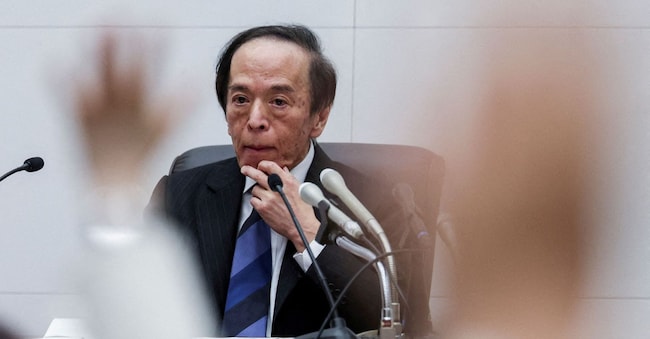
by Marco Masciaga

Il governatore della Bank of Japan Kazuo Ueda

3' min read

3' min read

From our correspondent

NEW DELHI - Faced with the climate of high uncertainty generated by US trade policies and the outbreak of a new war front in the Middle East, the Bank of Japan (BoJ) announced Tuesday that it was keeping its benchmark interest rate unchanged at 0.50 per cent. The decision - which did not surprise investors - came at the end of two days of meetings of the committee that decides monetary policy.

Loading...

"There are several risks. In particular, it is highly uncertain how trade and other policies will evolve in each jurisdiction and how economic activity and prices abroad will react to these policies," a BoJ statement read.

This is the third consecutive time that the Japanese central bank has decided not to change the cost of money. The last increase was in January.

The risk of rising inflationary pressures

.

"Given the global economic uncertainty and the geopolitical situation in the Middle East, I would say that at this stage the BoJ is in no hurry to continue normalising rates," explains Khoon Goh, Head of Asia Research for Anz in Singapore. "Our view," he continues, "is that the BoJ should proceed with normalisation because inflation seems stubbornly above the bank's 2% target. The weak yen is certainly one of the reasons for the upward pressure on inflation and, especially with the recent rise in oil prices due to geopolitical uncertainty, there will be further bullish risk in the near term, considering that Japan is a large importer of crude oil."

In April, core inflation reached its highest level in two years, standing at 3.5%, well above the BoJ's 2% target. Among the main causes was a surge (+7%) in food prices - despite the fact that the core figure by its nature does not take into account fresh produce, a very volatile item in an importing country like Japan.

After decades of deflation, the BoJ last year embarked on a path of normalisation of its monetary policy that had prompted it to raise rates three times starting in March 2024. A path that was changed by US President Donald Trump's announcement of 'reciprocal tariffs' on 2 April at the White House.

Faced with the impact of US protectionist policies on the world economy, the BoJ - in addition to leaving rates unchanged - had also revised down its forecasts for both inflation and GDP growth rates at its previous monetary policy meeting.

From next year, tapering on government bond purchases will come to a halt

The BoJ also published an interim assessment of the plan to reduce Japanese government bond purchases, announcing a slowdown in the pace of these reductions. Currently, the central bank reduces quarterly purchases by 400 billion yen (about $2.76 billion) each quarter. From April 2026, the pace will be lowered to ¥200 billion.

The central bank started reducing its purchases of Japanese government bonds in August 2024. With about 52% of the total, the BoJ is the largest holder of Japanese government bonds.

"By slowing down the pace of reduced bond purchases from the next fiscal year onwards, the BoJ has signalled some sensitivity to recent market volatility, especially at the long end of the curve," explains Charu Chanana, Chief Investment Strategist for Saxo in Singapore. "This move," she continues, "helps to avoid too sharp a spike in government bond yields, offering some relief to investors. However, by maintaining the current quarterly pace of ¥400 billion through April, it also reaffirms a steady and predictable exit path - consistent with Ueda's approach of gradually letting markets take control."

Copyright reserved ©
Loading...

Brand connect

Loading...

Newsletter

Notizie e approfondimenti sugli avvenimenti politici, economici e finanziari.

Iscriviti