
Electoral law: vote of confidence on three articles. Heading towards election day in May
The final vote will take place on Thursday by secret ballot. Malan (Fdi): elections could be held in May alongside the local council elections. The Democrats’ suspicions about Conte: he is working on a Plan B to pull out of the alliance

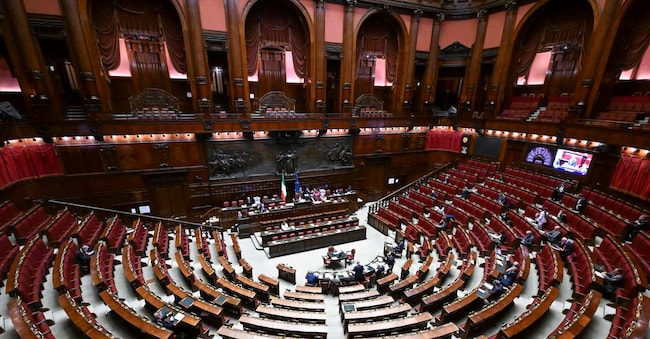
‘The government’s decision to call a vote of confidence on the electoral law is a serious slap in the face for Parliament. The truth is that the government is afraid of its own majority, of its stability and of a secret ballot, even going so far as to alter the seating arrangement of the Fratelli d’Italia MPs in order to control their votes. It is a terrible and authoritarian way of handling electoral matters.”
The government is calling a vote of confidence on three articles of the ‘Stabilicum’ or ‘Melonellum’ – whichever you prefer – and among those denouncing yet another instance of the majority forcing through its agenda in the Chamber is Federico Fornaro of the Democratic Party. A necessary political manoeuvre, of course, even though the move had been widely anticipated and even though the most recent precedent – the vote of confidence tabled in 2017 by the then PD-led government on the Rosatellum – stands as evidence that such high-handed manoeuvres are, so to speak, bipartisan. The fact remains that the chapter on electoral reform in Parliament is drawing to a close: two votes of confidence on Tuesday, a third on Wednesday, and on Thursday the final vote on the text by secret ballot to give the definitive green light. A development now taken for granted by everyone, given Giorgia Meloni’s ‘threat’ of a swift return to the polls should the bill be rejected in the secret ballot.
The election campaign leading up to spring
There is no doubt that the final go-ahead will officially kick off the long election campaign leading up to spring. Another indirect sign is the news that the Prime Minister has registered her voice with the EU Trade Marks Office to protect herself against possible multimedia manipulation using artificial intelligence (see the article on this page). This is because the date circled in red at Palazzo Chigi is election day, with local elections in the major cities taking place in May – ahead of the end of the parliamentary term in September–October – as Lucio Malan, leader of the Fratelli d’Italia parliamentary group, made clear yesterday. Perhaps a little rashly, given the determination of the Lega and Forza Italia to see the parliamentary term through to autumn 2027, hence the evening ‘correction’ under the banner of ‘the parliamentary term will run its course’: ‘The problem with a September vote is that you have little time for the election campaign,’ Malan argues. ‘And then there’s the budget bill to deal with, which is a very sensitive matter. So there might be a need to vote in May, and it might make sense to hold the general election alongside the local elections.’
The double-sided system
What Malan fails to mention is that the new electoral law provides for a system that is, so to speak, ‘two-faced’ (the term was coined by the political scientist Roberto D’Alimonte, who was the first to write about it in these columns): the majority bonus is triggered once a party secures more than 42 per cent of the vote; but if no party reaches this crucial threshold, the system reverts to a purely proportional system in the style of the First Republic. And avoiding a caretaker government is, of course, also in the Quirinale’s interest, given that a potential broad-based or national emergency government comprising parties that were ‘enemies’ during the election campaign would take several months to form. A scenario in which everyone falls below the 42 per cent threshold does not currently seem so far-fetched, given that in the polls – with Roberto Vannacci’s Futuro Nazionale polling at over 8 per cent – the centre-right coalition is already hovering just below or just above that mark.
The Open Field
Meanwhile, within the Democratic Party – as well as amongst Renzi’s supporters who gathered in Florence at the weekend for the Leopolda – there is a growing suspicion that the leader of the Five Star Movement, Giuseppe Conte, is drawing up a ‘Plan B’ as a possible way out of the alliance, either before or after the coalition primaries that the PD would like to hold at the start of the year. What is the point – one wonders – of raising the tone so much on the issue of ‘no more arms to Ukraine’ when the PD is in favour of full support, just like the entire European Socialist family?


