Art

Electric Dreams: Archaeology goes on show at the Tate Modern

The exhibition explores the encounter between art and technology from the post-war period to the 1990s

by Maria Laudiero

4' min read

4' min read

Contrary to popular belief, the link between art and technology has always had well-established correspondences that go back to the humanistic roots of the digital already traceable to an early form of computational language in Plato and Aristotle. From a more philosophical point of view, the 'resonance' between Creation, man and the new scientific-technological frontiers is even emphasised in a famous chorus of Sophocles' Antigone (335-375) in which this relationship is placed at the centre of a reflection whose themes are both ethical and philosophical, without neglecting the branch of robotics whose genealogy can be found in the first examples of self-propelled machines in the treatise 'On the Fabrication of Automata' by Heron of Alexandria (1st century AD) well before the advent of the digital age. AD circa) well before arriving in the early 1950s when Alan Turing theorised about 'intelligent' machines.

For a long time, creatives engaged in the various cultural spheres have been able to imagine, anticipating on heuristic assumptions, certain themes in the scientific sphere that would be pursued by those involved in technology at various levels, scientists, scholars, researchers.

Loading...

The exhibition

Electric Dreams, the major exhibition at the Tate Modern (until 1 June 2025) recounts the pioneering adventure of those artists who, between 1950 and the 1990s, explored the creative potential of new electronic tools, long before the arrival of the Internet.

The exhibition does not follow a linear narrative, but weaves together experiences and currents from all over the world. More than seventy artists found inspiration in scientific ideas, mathematical concepts, cybernetics and experimental devices. Technology, then, was a promise of collective transformation as community support.

Main themes and works

Electric Dreams is divided into thirteen thematic rooms, with over 150 works and more than 70 artists who have used emerging technologies such as computers, artificial intelligence, electronics and kinetic mechanisms to create interactive and sensorial art. Alternating within the itinerary are large installations and more intimate sections, in which affinities, exchanges and dialogues between artists emerge. These range from paintings inspired by the science of perception to the first experiences of virtual reality and audiovisual experiments of surprising modernity.

The exhibition is not just a historical retrospective: it is an invitation to reflect on our hyper-connected present and the role of technology in art. The exhibition invites us to consider how the insights of artists of the past can offer insights into understanding and addressing the technological challenges of the present.

L’Archetecnologia in mostra alla Tate Moderne di Londra

Photogallery12 foto

From interaction to participation

.

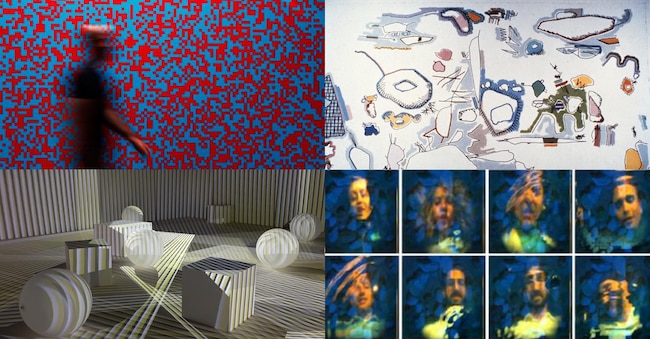
New disciplines such as cybernetics pushed artists to rethink the relationship between work and audience: no longer passive spectators, but active participants in a communicative system. Installations become immersive, manipulable, sensorial. This is the case with Liquid Views (1992), by Monika Fleischmann and Wolfgang Strauss, where the visitor is mirrored in a digital surface, in a game of electronic narcissism that anticipates the age of the selfie.

Meanwhile, computers shrank from giant industrial machines to domestic devices: a miniaturisation that opened up new creative possibilities. Many artists worked in laboratories as amateur engineers, recycling consumer electronics or accessing expensive equipment through collaborative networks.

The works on display

.

At the beating heart of the exhibition is a work that tells a lot about the relationship between image, technology and visual experimentation: it is Matrix II, created by video art pioneers Steina and Woody Vasulka, which contributed to the birth of video art as an experimental language, with art meeting 'domestic' technology. In this hypnotic work, geometric shapes move fluidly across a grid of CRT monitors - the classic CRT televisions that dominated the market until the early 2000s. The Vasulkas did not limit themselves to using these screens as simple supports, but tested their physical and visual limits. Each monitor is treated as a living instrument, to be 'played' with electronic waves, until a visual movement is achieved that recalls the very behaviour of the electrical signal.

Some, like Atsuko Tanaka, literally dressed electricity: her Electric Dress, created in 1956 and composed of industrial light bulbs, wires and neon tubes, is one of the most iconic images of the exhibition that reflected the new electrification of post-war Japanese cities. A "painting that moves", as she called it, this idea runs through all her early work and is symbolic of an art that becomes body and action. The photograph on display shows the artist preparing for a performance during the Second Gutai Art Exhibition at Ohara Hall in Tokyo in 1956.

Others, however, have entrusted creation to the algorithm. This is the case of Harold Cohen, a pioneer of artificial intelligence applied to art, who used his AARON software to give life to autonomous drawings, anticipating by decades current reflections on generative AI.

François Morellet with The Random Distribution of 220,048 Squares Using Pi (1963), a work that uses mathematics to create an algorithmic visual composition. Morellet was a French artist known for his systematic, conceptual and often ironic approach to abstract art. In The Random Distribution of 220,048 Squares Using Pi, Morellet explores the idea of randomness regulated through the use of mathematics and in particular the number π (Pi). The work is based on the use of the decimal digits of π, an irrational number with an infinite and seemingly random sequence of numbers. Morellet takes these digits as the basis for determining the position (and/or presence) of 220,048 squares on a surface, following a strict system. The use of an algorithm or numerical system to create a visual result refers back to the concept of generative art. Morellet's work is a brilliant example of how logic, mathematics and art can merge to produce an aesthetic and conceptual experience at the same time.

Electric Dreams, Tate Moderne, London, until 1 June 2025

Copyright reserved ©
Loading...

Brand connect

Loading...

Newsletter

Notizie e approfondimenti sugli avvenimenti politici, economici e finanziari.

Iscriviti