
Electric mobility: the real challenge lies in the grid
The growth in battery-powered cars marks the start of a new phase in the transition: charging points alone are no longer enough; we need smart infrastructure capable of integrating energy, data, storage and renewables. Part of the country’s competitiveness hinges on this convergence

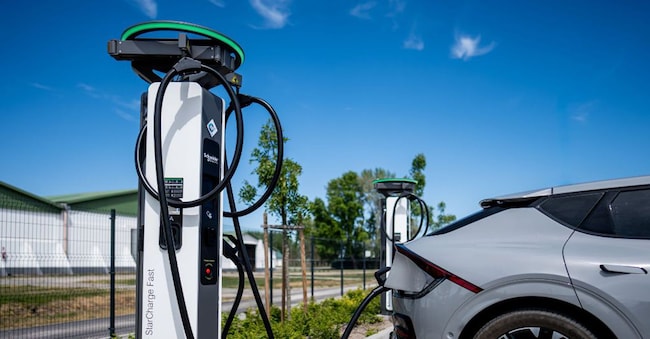
Electric mobility in Italy is entering a new phase. The issue is no longer simply how many motorists will opt for a battery-powered vehicle, but whether the energy system will be able to support a transformation set to change consumption patterns, grids and infrastructure. For the transition to accelerate, there must be sufficient charging points to support the number of cars, but above all a network capable of intelligently managing an increasingly widespread and variable demand for energy.
The figures show a market which, whilst still lagging behind the major European countries, is gaining ground. According to Motus-E, there were 444,863 electric cars on the road in Italia in August; registrations for the month totalled 4,377, accounting for a 6.32 per cent share, compared with 4.85 per cent a year earlier. In the first seven months of 2026, there were 86,003 new BEVs, 70.4 per cent more than in the same period of 2025. At the same time, the infrastructure has expanded: there are 84,564 registered charging points.
This is where the second phase of e-mobility begins. Increasing the number of charging points is necessary, but it is not enough. A domestic wallbox rated at 7.4 or 11 kW already represents a significant load; in a block of flats, a business park or a shopping centre, dozens of points operating simultaneously can require hundreds of kilowatts. With High Power Charging (HPC) stations, where a single socket can deliver 60, 300 or over 600 kW, the issue becomes even more apparent. In short, the challenge shifts from simply ensuring charging is available to the ability to manage it.
This means preventing all users from demanding maximum power at the same time, distributing loads according to grid availability, and coordinating consumption, renewable energy generation and storage systems. It is also a decisive step for competitiveness: the electrification of transport cannot develop as a system separate from the energy system, but must become a manageable and flexible component of it. This transformation affects not only motorists and manufacturers, but also utilities, businesses, local authorities and property managers, who are called upon to plan networks and facilities today that will support progressively higher charging volumes.
Incentives can accelerate demand – the 2026–2030 framework provides for measures for vehicles and infrastructure, and new instruments are expected from September – but the maturity of the market will increasingly depend on the quality of the ecosystem built around the car. Furthermore, looking ahead, the relationship could become bidirectional. With Vehicle-to-Grid (V2G), electric vehicles will not merely be energy consumers: when cars are connected, their batteries will be able to contribute to the flexibility of the system, interacting with the grid, storage facilities and renewable energy sources. The car, once a simple means of transport, thus becomes a distributed energy resource.
It is this paradigm shift that underpins theSchneider Electric approach. The company starts from a basic premise: electric mobility is no longer just an automotive issue, but a convergence of infrastructure, energy, digital technology and competitiveness. For this reason, it proposes an integrated management system that combines charging solutions – designed for private and public sectors as well as fleets – with energy management platforms capable of dynamically controlling power output and optimising consumption.
The aim is to ensure that the charging point is not an isolated asset, but a node connected to the energy and digital infrastructure of the building, factory, car park or city in which it is installed. In this context, the software plays a role just as important as the hardware: understanding demand, modulating loads and using energy at the most cost-effective times makes it possible to increase the number of charging points without automatically turning every new installation into a demand for greater power from the grid.
The same approach applies to company fleets, for which electrification introduces an additional layer of complexity: many vehicles need to be charged in the same location and often during the same time slots, whilst buildings and manufacturing operations continue to consume energy. Managing this consumption separately results in a loss of efficiency; coordinating it, on the other hand, allows for better use of available power and enables charging to be scheduled according to actual operational needs.
The next step is to increasingly integrate charging, renewable energy generation and storage, right through to future models of flexibility and V2G. It is this convergence upon which Schneider Electric is building its technological offering: not simply adding new sockets to the grid, but making e-mobility part of a more digital and manageable energy system. With the ever-wider uptake of electric mobility, the true enabling infrastructure will not be one that merely supplies energy, but one capable of deciding how, when and where to use it.

