
Electrolux will not take unilateral action. Urso: new meeting on 21 July
At the meeting at the Ministry of Infrastructure and Transport, Minister Urso reiterated that a fresh start is needed and that the plan involving over 1,700 redundancies is unacceptable: the hope is that an agreement can be reached within the next 50 days

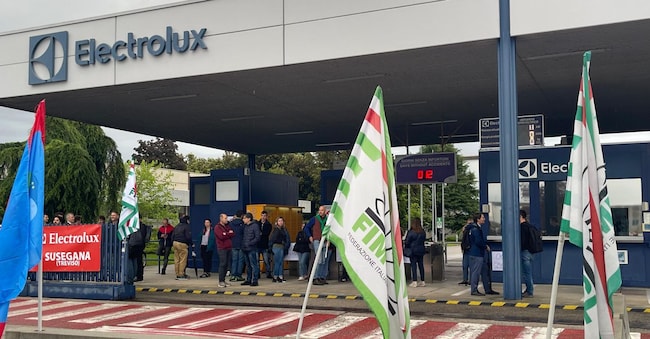
Electrolux will not take unilateral action. At the meeting on Monday 15 June at the Ministry of Economic Development, the multinational announced its willingness to discuss joint measures, ruling out unilateral redundancies and closures. Less than 24 hours later, at the Assarmatori annual meeting in Rome, the Minister for Enterprise and Made in Italy, Adolfo Urso, explained that this is not ‘an armed truce’, as the FIOM has claimed, but rather “a new beginning, a substantive dialogue to reach a solution that I believe can be agreed upon – namely, investment in the productive relaunch of Italian plants, whilst recognising that we must simultaneously meet our targets in Europe”. For this reason, Urso explained that he intends to ‘convene a new meeting of the negotiating table for 21 July, and on that date we will take stock of the process that has already begun today with technical meetings, with the aim of finding an alternative solution that is fully agreed upon and sustainable with the company, and of course with the support of our trade unions and the regions where the plants are located’.
Sources present at the meeting on Monday 15 June report that Minister Adolfo Urso had called for a packed schedule of meetings with a view to reaching an agreement by the start of August, i.e. the period when the summer holidays begin. There are therefore roughly 50 days, or 7 to 8 weeks, during which there will be a packed schedule of meetings between the parties to try to achieve the outcome Urso is hoping for, namely a sustainable agreement. The plan presented by the company in recent weeks, involving over 1,700 redundancies and closures, as the minister reiterated, is unacceptable and cannot serve as a starting point. Nor can it be an end point.
For the trade unions, this is very positive news, even though, as Davide Sperti, the new general secretary of Uilm who has succeeded Rocco Palombella, says, ‘the situation has not been definitively resolved. However, the plan has been put on hold and the company will not unilaterally take any action. I believe this is a first step forward that we can welcome with cautious optimism and that is the result of the joint protests held over the past few weeks’. At the very least, it can be said that ‘the agenda with which the company intended to tackle the dispute has been altered’, starting with the 1,719 redundancies, adds Michele De Palma of Fiom: ‘We have stopped them, we have won, you have won, but the battle is not over. This is an armed truce between us and Electrolux.”
Political commitment put to the test
The General Secretary of Fim, Ferdinando Uliano, says that ‘the political commitment that has been made is very important’, but ‘we want to see it put to the test’. It’s not as if the company will wake up in a few weeks’ time and announce that it’s going back to the old plan. As far as we’re concerned, the discussion must focus on alternatives, starting with redundancies. For us, the commitment of the political institutions is important. There hasn’t been a single region that hasn’t committed to providing financial resources to build an alternative plan to redundancies and closure. I want to see this put to the test; I don’t want to find ourselves in a few months’ time with no funds available and the problem back on the table’. Equally important, for Uliano, ‘was the government’s commitment to changing the rules and the situation we face in Europe, which create a situation where our products are being trampled on in the market by dumping by other foreign producers. So if this commitment exists, it must be seen through to the end, and I say to this government that since one of the issues is the energy issue that puts businesses out of the running, then the government must finally do its bit, open up the household appliances sector, and draw up proposals with dedicated resources in our country and in Europe’.
Vannia Gava, the Deputy Minister for the Environment and Energy Security, who took part in the meeting, spoke of “moderate satisfaction with the company’s willingness to engage in discussions aimed at identifying an alternative plan”. What is needed now is the commitment of all parties to foster a credible path towards recovery and overcoming the crisis, based on transparency and mutual trust. The Government will continue to fulfil its role of coordination and assurance, so that the work carried out over the past few weeks yields concrete solutions, avoiding the risk of finding ourselves, in a few months’ time, back at square one. The objective remains clear: to protect jobs, safeguard our industrial heritage and strengthen the competitiveness of a sector that is strategic for the country.”

