
Helen, pilgrim in the Holy Land and face of power
Francesca Ghedini sketches the women who lived around the emperor who granted freedom of worship to Christians
3' min read
3' min read
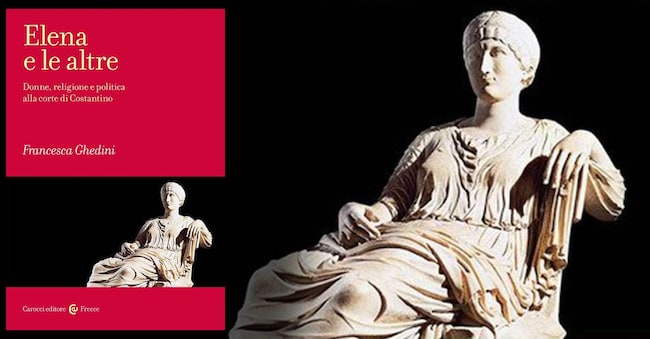
Half a century of Romanity, mended with the painstaking comparison of sources and a search made up of dozens of hypotheses and flashes of certainty. Francesca Ghedini, professor emeritus of Classical Archaeology, proposes with her Elena e le altre. Donne, religione e politica alla corte di Costantino a reconstruction of the women who revolved around the emperor, and she does so with the method we have seen in her lectures on classical archaeology at the Liviano in Padua. Back then, thirty years ago, Ghedini was a research visionary; today she has many followers. And this new study goes in that vein: literary, epigraphic and numismatic sources, artefacts and iconographies for as complete a picture as possible.
That half-century of Romanity is also made up of Helena, Constantine's mother, his wife Fausta, Minervina who bore him his son Crispus, his stepmother Theodora, his three stepsisters (Constantius' daughters, Constantia, Anastasia and Eutropia) and his two daughters, Constantina and Helena, to whom, Ghedini recalls, "fate reserved for them too the treatment that was reserved for all women born at the top of power: to become an instrument for palace agreements". The reconstruction was not easy: unlike the women of the Caesars in the first centuries of the empire, the documentation concerning female figures in the first half of the 4th century AD is scanty. In the years following the fall of the Severan dynasty, barbarians press the borders, family feuds and fratricidal wars cripple a languishing empire, the great aristocracy no longer plays a role and the economic crisis is rampant. Within this framework, female figures enter and leave history as quickly as their men come to power or are driven out of it.
Certainly, the woman who most marks Constantine's life is his mother Helena, to whom history acknowledges a fundamental role in promoting Christianity but whose last years of life are only reconstructed by the sources. She was born shortly before the middle of the 3rd century, if it is true what Eusebius wrote, that she died in her eighties between the end of 328 and the early months of 329. Even the place is unknown: Procopius of Caesarea, who lived two centuries later, indicates Drepanum, today Hersek, in Turkey but there are numerous claims, Trier in Gaul, Camulodunum (Colchester), in Britannia. These were years of great instability, in which fear and uncertainty favoured the slow affirmation of monotheistic instances with Christianity and its light in the Afterlife carving out ever greater spaces.
Helen's origins are humble: for the Christian Ambrose, bishop of Milan, she is stabularia, innkeeper, and he adds the adjective bona, which in ethical and moral terms means a loyal and honest person, but also virtuous and chaste. Where she met Constantius Chlorus, Constantine's father, is not known but it is likely that she followed him in his wanderings in later years, since the fruit of their love was born between 272 and 274 in Naissus (in Serbia). Then, Constantius married Theodora and Helena chose solitude and the shadows. It is his son Constantine, once acclaimed emperor by the army and the empire pacified, who summons Helena to court, granting her the title of nobilissima femina, the same given to his wife Fausta.
In 312 A.D. Constantine defeated Maxentius at the Milvian Bridge, of the following year was the Edict granting freedom of worship to Christians and the christogram dominated the iconography; on the reverse of a Constantine follis is one of the oldest examples showing the labarum surmounted by the first letters of the name of Christ. At the time, Helena adhered to the policy of openness to Christian belief as confirmed by the building works, financed by Constantine, that affected the fabric of the capital after the victory over Maxentius. Equally important is the journey to the Holy Land on which Ghedini wisely interweaves all the sources to conclude that "the journey was a sophisticated and complex propaganda operation that responded to multiple instances: alongside the personal need to manifest full adherence to the Christian religion, no less cogent was the desire to be perceived as the face of power in a key that was entirely in line with imperial customs. The 'pilgrim' Helena embodied the model of an empire that, although Christianised, moved in the wake of tradition: with the amnesties the Augusta presents herself as the guarantor of the clementia and the justitia of her emperor son, with the handouts to the military she becomes the symbol of liberalitas, while as mater castrorum she represents the virtus, who ensures the security of the borders". In short, Helen the champion of faith and a woman of power.


