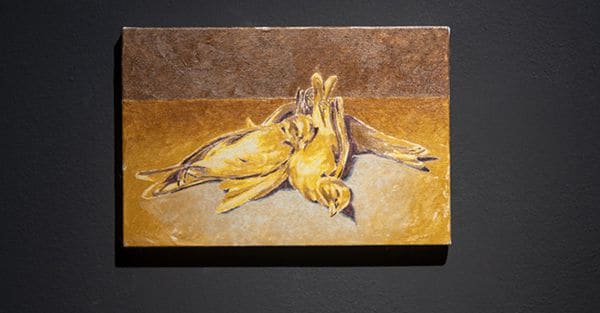
Eleonora Rinaldi. Órama: getting lost between dream and reality in Venice
Ca' Pesaro - International Gallery of Modern Art in Venice hosts the artist's solo exhibition until 27 September

2' min read
2' min read
The exhibition project, consisting of seven works created in Paris in 2025, develops around the concept of vision, understood as the threshold between reality and imagination. The title Órama, from the Greek word for "vision" or "dream", recalls the profound link between sensory perception, inner reworking and the stimuli of nature.
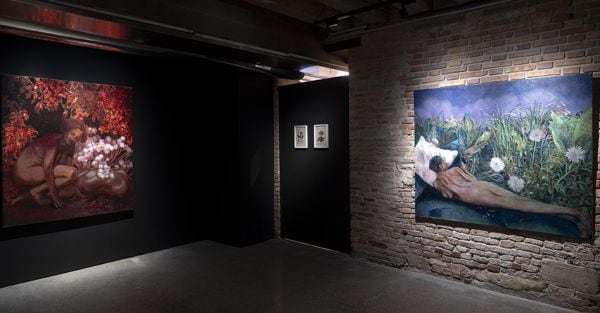
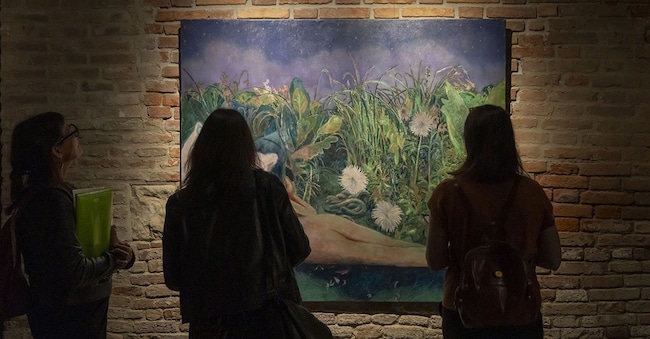
Rinaldi's paintings depict landscapes poised between empirical data and dreamlike suspension, where vegetation regains space at the expense of the anthropomorphised world. The human figures thus merge with the leaves and the tangle of flora, in a dense web of colour and formal synthesis that evokes Fauve, symbolist "à la Rousseau le Doganiere" and surrealist suggestions. Nature is therefore not an inert backdrop but pulsating matter that intoxicates the scene with its moods, in a suspended and fictitious dimension that also involves the spectator on an emotional level.
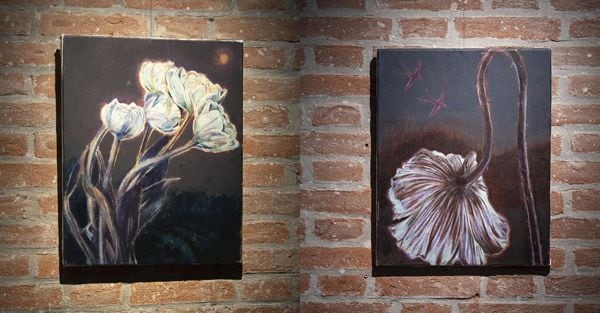
The inner experience, in a dimension that chews memory and fantasy, sensation and drive as if they had the same thickness, takes shape in visual representation. Rinaldi's works reflect the way dreams alter - or reveal - reality, suggesting an immersive, almost hallucinatory experience. Coleridge, Jung and Oliver Sacks enrich the reflections of curators Francesco Liggieri and Christian Palazzo, aimed at emphasising the centrality of vision as a creative act.
Between autobiography, literature and history
The works of Eleonora Rinaldi (Udine, 1994) stem from a process of collecting and reworking visual and narrative fragments, mixing autobiography, literature and history. The drawing is the starting point of a layered painting; the pictorial compositions invite one to lose oneself in the vibrant colours and luminous halos, beyond space-time coordinates, arousing amazement, fragility and wonder.
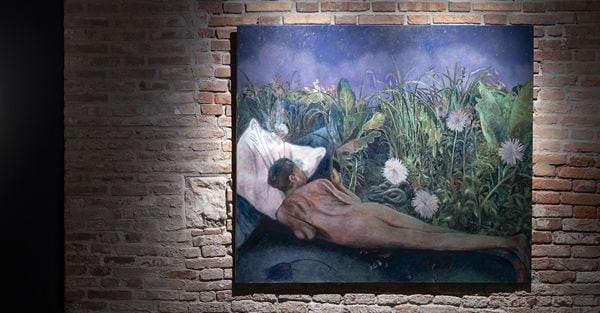
The viewer is plunged into velvety atmospheres where sparse flower stalks dispel the darkness. In the painting 'L'idée du Déluge', amidst the tufts of grass, a brood of reptiles is curled up next to a female body, lying on the bank of a pool of water. The nymph, with her head resting on a pillow and a log, perhaps sleeping, seems to regain an innate wildness. The title of the painting takes up some passages from Arthur Rimbaud's Les Illumination: 'As soon as the idea of the Flood had subsided, a hare stopped between the hay and the moving bells and recited its prayer to the rainbow through the spider's web. Oh! The precious stones were hiding, the flowers were already peeping out'. Going on, we also read: 'Since then, the Moon heard the jackals howling in the thyme deserts, and the hoofed eglogues rumbling in the orchard. Then, in the purple wood, luxuriant, Eucharis told me it was spring'. The purple wood comes to life through painting, the muffled corollas emerge like firecrackers in the moonlight.