
Eleven reactors in five years: how China accelerates on nuclear power
The government approves the construction of new plants, with a record $31 billion investment. The goal is to overtake France and Germany in atomic energy production by 2030
3' min read
3' min read
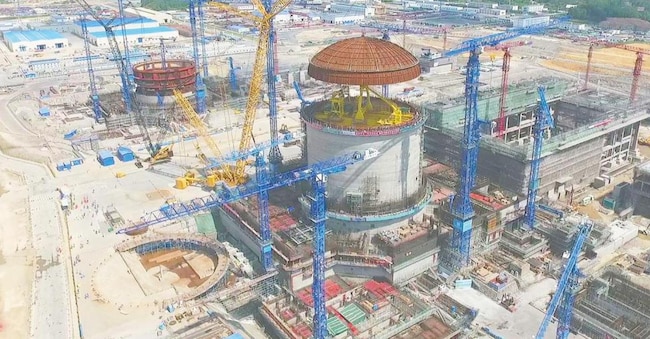
The drive, as always, is triggered by autarky, and in nuclear power too China aspires to self-sufficiency. There is no time, energy must be produced and emissions reduced, so as much as 31 billion dollars have just been drummed into eleven new reactors at five sites. The State Council-NDRC transmission belt, which is the Communist Party's economic arm, feeds a nuclear energy production chain that has now reached 433 billion 371 million kilowatt-hours by 2023.
The country has 56 reactors currently in operation, with a combined capacity of around 5% of total electricity demand, according to data from the China Nuclear Energy Association. As a result, China is second in the world in terms of production and has also cut its use of standard coal by more than 130 million tonnes.
The goal is to overtake France and the United States as the leading generator of atomic energy by 2030.
The Blue Book presented on 15 April by the China Nuclear Energy Industries Association, the China Nuclear Energy Development Report 2024, already charted the course by anticipating the latest steps that have just been taken, from the operation of nuclear power, to plant construction, to scientific and technological innovation.
According to the Blue Book, the construction of nuclear power plants in China is steadily advancing, especially the design of new projects now uses almost entirely Chinese-made components.


