
Emeralds, rubies and sapphires have a problem: transparency
The denunciation in a report: despite the industry's growing demand for more and more, information on the provenance of gems is still too scarce and vague. Blockchain technology can be a solution to protect brands and consumers


3' min read
3' min read
Just as on safari people hunt (increasingly photographic, fortunately) for the big five, in mining people look for the big three: animals on the one hand, gems on the other, united by being preciously rare. Demand for the three most desirable stones - rubies, emeralds and blue sapphires - is steadily increasing, especially after Covid: according to a recent report by The Business Research Company, global gemstone sales will grow at an average annual rate of 6.3% by 2029, rising to $42.7 billion in turnover from an estimated $33.4 billion by 2025.
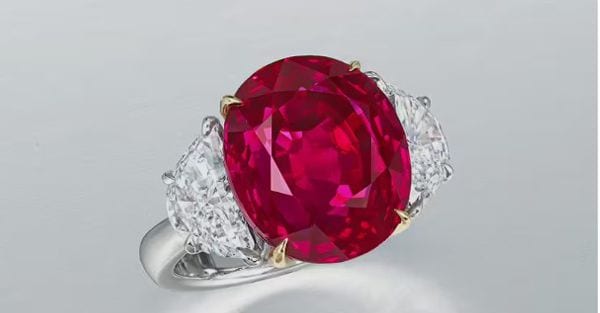
The intensity of this hunt is also confirmed by the buying trends at auctions: last December, in New York, Sotheby's fetched a ring with a rare Burma ruby for $5.5 million, i.e. more than double the highest estimate. On 27 May in Hong Kong, Christie's will be hammering two fabulous rings: one with the blue sapphire 'Regent Kashmir', which is estimated to fetch up to $12 million, the other with the exceptional 'Royal Ruby' which is expected to fetch up to $10 million. These figures too will be exceeded very easily, thanks to their unusual carat, quality and provenance.
However, while for gold and the diamonds the industry has shaped protocols and certifications that support the ethicality of the supply chain, e.g. with Fairmined and the Kimberley Process, this road to transparency for the big three coloured gems still seems to be weakly traced. This is supported by another report, "Understanding the global supply of emerald, ruby and sapphire", published last February by Gemfields, one of the largest gem mining companies on the planet, and carried out by GeoGems, a respected industry consultancy, which interviewed over 100 companies and experts.
Together with competitor Fura Gems, established in 2017 and based in Dubai, Gemfields (founded in 2007 and based in London) is the only company in the industry to have adopted a traceability system for gems extracted from its mines in Africa and South America, based on blockchain technology developed in 2019 by Gübelin, which testifies to the ethicality of each of its processing and marketing stages. An important choice in an industry characterised, as the report shows, by a dramatic lack of information on the quantity, quality and movement of gems around the world to be cut, polished and marketed. Several factors define this situation: among the most relevant, it says, is the fact that such data could affect the perception of the rarity of the gems themselves, or that they could attract geopolitical aims.

This is what happened, for example, in Mozambique, which, with the discovery of the first ruby deposits in the late 1990s, and the sanctions imposed shortly afterwards on the military government of Myanmar, which was among the first exporters, became the world's leading producer: in the Montepuez area, both Gemfields and Fura Gems own mines that periodically have to stop production due to the unrest following attacks by the gampeiros, organisations of illegal miners.


