Emerging countries drive the smartphone market. Apple queen
But 2026 is expected to be a slowdown due to chips and memory, with manufacturers more enticed by the AI server market

Key points
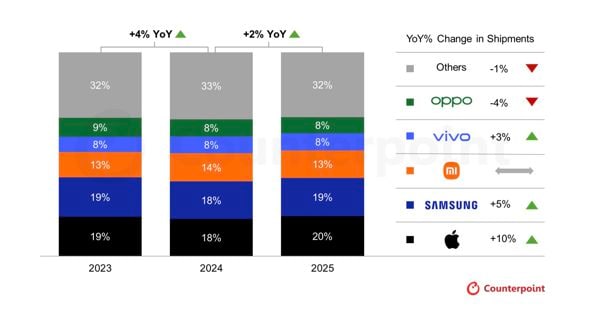
The smartphone market continues to grow. Global shipments closed the year 2025 with +2%, marking the second consecutive year of expansion after a long period of stagnation. And driving the market were mainly emerging countries, the accelerated deployment of 5G devices and a gradual shift in demand towards higher-end models (i.e. more AI-focused smartphones).
According to Counterpoint Research's preliminary estimates, the sector maintained a steady growth pace for much of the year, despite concerns related to the tariffs threatened and then partly imposed by Trump, and a still uncertain macroeconomic environment in many advanced economies.
It must be said, in fact, that trade tensions prompted several producers to anticipate shipments in the first half of 2025, in order to shelter themselves from possible tariff increases. But as the months went by, the impact proved to be smaller than expected, leaving volumes for the second half of the year largely unchanged.
Counterpoint's data showed uneven growth. Offsetting the weakness in mature markets were countries such as Japan, several areas in the Middle East and Africa, and some regions in Asia-Pacific. Here, demand for 5G devices and upgrades to more expensive smartphones supported sales, while in the US and Western Europe the replacement cycle was slower.
Apple queen
Against this backdrop, and looking at the manufacturers in detail, Apple confirmed its global leadership with a 20% share and 10% year-on-year shipment growth, the highest among the top five manufacturers. The Cupertino giant benefited from solid demand in emerging and mid-sized markets, as well as a product mix more oriented towards the high-end.