
With its new Pact for Employment, Climate and the Social Economy, Emilia-Romagna is turning the challenges of the present into opportunities for the future
The new document reaffirms the priorities, updates the strategic objectives agreed upon in previous years and aligns the Region’s vision for the future with current and changing local and global circumstances

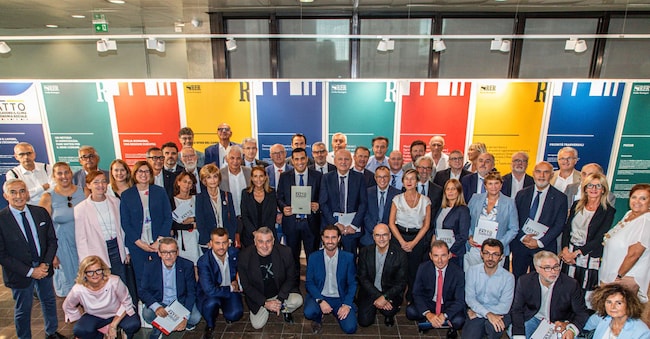
(Il Sole 24 Ore Radiocor) - Reducing social and regional inequalities, moving beyond the old dichotomy between the economy and the environment, whilst also investing heavily in the social economy and transforming the challenges of the future into opportunities for the younger generations, placing people and communities at the heart of change. These are the guiding principles of the new Emilia-Romagna Pact for Employment, Climate and the Social Economy. Unveiled in July and recently signed by all the signatories alongside the President of the Region, Michele de Pascale, and the Vice-President, Vincenzo Colla, it is a governance instrument that is unique in Italia.
It renews the alliance between social partners, economic actors and institutions, which are joining forces to tackle the challenges of employment, growth, the green transition and the fight against social and regional inequalities. The new action plan consolidates the strategic priorities of previous agreements, whilst at the same time adapting them to contemporary challenges. For example, whilst in 2015 the top priority was employment in response to the global economic crisis, in 2020 the issues of climate change and sustainability were added in the midst of the pandemic emergency. And today, in 2026, the Pact is being renewed once again and broadens its focus to include the social economy, redefining the vision for the future of Emilia-Romagna.
The objectives
The new Emilia-Romagna Pact for Employment, the Climate and the Social Economy follows a long and fruitful dialogue with institutional, economic and social representatives, and aims to update the region’s vision for the future, drawing on what has happened and is happening at local and global levels. In particular, the need to safeguard public healthcare as a democratic guarantee of health protection – a fundamental right of the individual and a matter of public interest – has become urgent. The increasingly extreme consequences of the climate crisis have also brought to the fore the urgent need to invest in the safety of the region, which has laid bare all its vulnerabilities.
Furthermore, economic and employment instability, stemming from ongoing conflicts and shifts in the international landscape, exacerbated by tariffs and the rapid rise in energy costs, calls for a joint commitment to the competitiveness of local production sectors. Added to this are inflation, which has impoverished a section of the middle class and made it difficult for many people to access basic necessities, first and foremost housing, and demographic trends, which in Emilia-Romagna show a positive trend only thanks to the region’s appeal, which has for several years now been offsetting a structurally negative natural balance. These are complex challenges that have made it necessary to draw up a new Pact that takes a holistic view of regional society in order to understand its new needs, interpret its expectations and fulfil its ambitions.
A pact to drive change
“Our aim is to drive change, not to be at its mercy, by pooling our strengths and collective intelligence for the common good. This is the challenge facing Emilia-Romagna during an unprecedented period of global transition,” commented President de Pascale and Vice-President Colla at the signing of the Pact. “Despite the enormous difficulties linked to the climate crisis, inflation, geopolitical instability and the need to defend wages and public healthcare, the Region has chosen to respond with concrete actions rooted in local communities,” they continued - “By incorporating the social economy into the new Pact for Employment and Climate, we are demonstrating that development, environmental protection and social cohesion can and must go hand in hand.”


