
Emissions, the path to net-zero by 2050 and the role of business
Industry, with energy production and manufacturing, is among the sectors most responsible for emissions. And among those that have cut CO2 the most in recent years
3' min read
3' min read
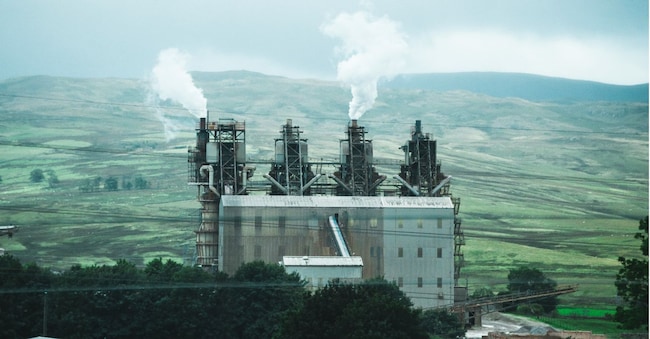
Cement factories, steel mills, paper mills, glassworks, chemical, energy companies: these are the hard-to-abate industries, where cutting CO2 is most difficult, due to the large quantity of fuels used and the production processes that, by their nature, generate carbon dioxide as a by-product. They are among the biggest emitters, although their contribution has improved over the years. And there is still a long way to go to achieve the carbon neutrality, or net-zero, by 2050 demanded by the EU, whereby all greenhouse gases produced must be offset.
The role of industries
.According to the latest Ispra data for 2023, the sectors that produce the most greenhouse gases are transport (28% of the national total), energy production (21%), residential (18%) and manufacturing industry (13%), agriculture (8%) and industrial processes (6%). Ispra notes that in 2023, national emissions are 26% below 1990 levels. This trend is due to increased energy efficiency from renewable sources in industrial sectors and a shift to the use of lower carbon fuels. Greenhouse gas emissions are also down from the previous year (2022) by 6.8% to a total of 385 million tonnes of CO2 equivalent.
Emission targets
.Specifically, the decrease is mainly attributable to the reduction of emissions from energy industries, which cut emissions by 47.3% in 2023 compared to 1990 despite an increase in production, manufacturing (-45.2%) and industrial processes (-40.5%). On the other hand, emissions from the transport sector, more than 90% of which come from road transport, are up more than 7% since 1990. This has caused an insufficient slowdown in emissions: in the context of national targets set by the European Effort Sharing regulation, which requires Italy to reduce emissions from transport, residential (heating of buildings), agriculture, waste and non-Ets industry by 43.7% by 2030 compared to 2005, Italy's failure to reduce transport emissions has led to Italian emission levels gradually approaching the maximum allowed ceilings, until they are exceeded in 2021 (by 5.5 million tonnes of CO2 equivalent) and in 2022 (by 5.4) and 2023 (by 8.2), again certified by Ispra and for which penalties may be imposed in the coming years.
The Ets System
.The companies subject to the Ets (Eu emissions trading system), the European system for trading green certificates to offset emissions, are precisely those that are hard to abate. The last available report compiled by the Gse and relating to the first quarter of 2025, indicated a total value of auction proceeds for certificates in Italy of 655.6 million euro (+22% on 2024), from which the economic commitment of companies can be deduced. Which should, however, finance the transition: the proceeds from Eastern auctions support Decree-Law No. 19 of 28 February 2025, which allocates €600 million for 2025 to finance the Energy Transition Fund in the industrial sector, increasing its endowment compared to what was previously established. Or Decree-Law No. 208 of 31 December 2024, which allocates, for the period 2025-2027, €45 million per year to finance the activities of the GSE as guarantor of last resort in PPA (power purchase agreement) contracts.
Technologies
.As far as technologies are concerned, in addition to electrification, with the development of renewables and related storage and grid systems, experiments with hydrogen - on which the high production costs continue to weigh heavily - and progress on the CO2 capture front, with Eni and Snam engaged in setting up the first infrastructure of this type in Italy, in Ravenna, and feasibility studies begun by cement factories and incinerators, there is great ferment in the field of biomethane. The process that from the anaerobic fermentation of animal dejections, agricultural waste, and the organic fraction of waste produces the gas that we use to heat ourselves, ready to be fed into the grid, is attracting investments and projects, driven by the incentives of the NRP that have just been given the green light by the European Council for an increase in the quota initially dedicated.


