
End-of-life tyres, the second life of recycled rubber between circular economy and new uses
The collection volume of car, lorry and agricultural wheels is growing. About 350,000 tonnes are recovered in one year
by Davide Madeddu (Il Sole 24 Ore), Petr Jedlička (Denik Referendum, Czech Republic), Ana Somavilla (El Confidencial, Spain) and Ieva Kniukštienė (Delphi, Lithuania)
 Aggiungi Il Sole 24 Ore
ai preferiti su Google
5' min read
5' min read
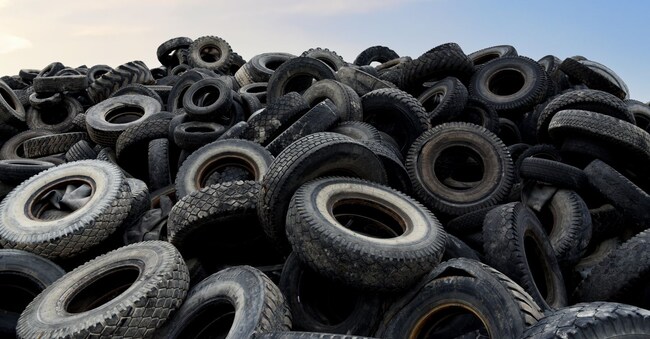
The second life of end-of-life tyres passes through new initiatives ranging from asphalt to insulation products, from gymnasium tiles to rubber barriers placed over guard rails. It is the circular economy applied to the reuse of rubber from end-of-life tyres. Materials that do not become waste but are transformed into new raw material, after a series of steps ranging from washing to shredding and then further processing. In Italy, the collection of end-of-life tyres is growing, and every year the assigned collection target is exceeded.
According to a study carried out by the Ecopneus consortium, "every year about 350,000 tonnes of tyres reach the end of their life from replacement on vehicles in circulation". In addition, "an estimated 30 million car tyres, 2 million truck tyres, 3 million two-wheel tyres, and over 300,000 industrial and agricultural tyres are disposed of annually". The latter represent only 0.9 per cent in quantity, but more than 4 per cent in weight, due to their large size.
Avoiding the emission of 297 thousand tonnes of CO2
As far as 2024 is concerned, Ecopneus managed over 168 thousand tonnes of Pfu, responding to 45 thousand collection requests and exceeding the statutory collection target by 10%. In terms of environmental benefits, thanks to Ecopneus's recovery and recycling activity, in 2023 the emission of 297 thousand tonnes of CO2 equivalent (tCO2eq) was avoided, a quantity equal to those of 183 thousand cars that travel 10,000 km in a year, 1.2 million m3 of life cycle water was saved, a volume equivalent to the average daily consumption of about 5.6 million Italians or the amount of water needed to fill 484 Olympic swimming pools. In addition, a net saving of 274,000 tonnes of mineral and fossil resources was generated, an amount equal to the weight of 558 Frecciarossa 1000 trains consisting of eight carriages plus locomotive.
Cutting imports and saving EUR 81 million
Benefits to which must be added the savings for the country linked to the reduction in imports of virgin material, to the value of 81 million euros," the Ecopneus Consortium reports. Benefits that, added together, also generate a significant contribution in economic terms: last year, Ecopneus' activities generated an economic value of 44.4 million euros, of which as much as 40.5 million served to remunerate the companies in the supply chain for recovery, collection, transport and treatment operations. The remaining 12% represents the Consortium's internal management costs (communication, employee salaries, taxes and other costs), which in 2023 will amount to EUR 5.3 million'.
The insulation for music rooms
.Then there are the other uses for the rubber that comes from end-of-life and discarded tyres. One of the latest initiatives concerns the use for lining music halls and auditoriums. Recycled rubber from end-of-life tyres is emerging as a solution that combines excellent performance and sustainability. Thanks to its extraordinary sound absorbing and soundproofing capacity, this material significantly improves the acoustic experience, creating ideal environments not only for music but for different architectural contexts.

