Energy

Supercomputer, Enea turns on Cresco8: it will help nuclear fusion research

Cresco8 will support the experiments of the Diverter Tokamk Test project, the machine under construction in Enea's Frascati laboratories that will test clean nuclear solutions and pave the way for Europe's first demonstration reactor

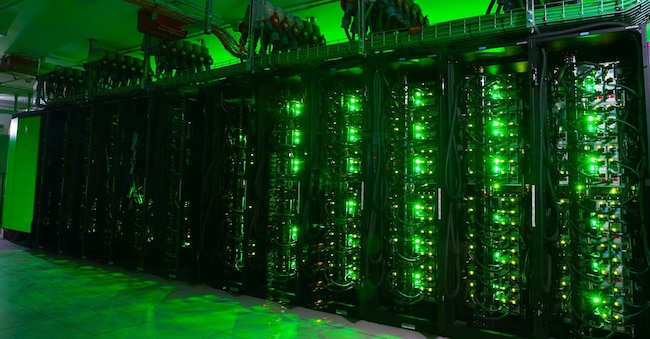
Il supercomputer Cresco8 di Enea

3' min read

3' min read

The Italian supercomputing network turns on a new node. The National Agency for New Technologies, Energy and Sustainable Economic Development (Enea) has inaugurated the supercomputer Cresco8. This supercomputer, financed with funds from the Next Generation EU programme, was created with a well-defined task: to contribute to Italian-made research for nuclear fusion, at the rate of 9 million billion operations per second. In this context, the supercomputer will enable optimised management of the vast databases generated by fusion experiments.

Installed at the Enea Research Centre in Portici, the new supercomputer will be accessible to universities, public research organisations and companies in need of advanced computing resources for high-performance computing (Hpc) applications.

Loading...

VIAGGIO NELL’ITALIA DEL SUPERCALCOLO

Loading...

Supercomputing for nuclear fusion

.

With numerical simulations that are more advanced than those of its predecessors - Cresco6 and Cresco7 - complex models and big data analysis, Cresco8 will support the experiments of the Divertor Tokamak Test (DTT) project, the machine that will test solutions for clean nuclear power under construction at Enea's Frascati laboratories. A 600 million euro project.

In particular, CRESCO8 will play a crucial role in the PNRR Divertor Tokamak Test Facility Upgrade (DTT-U) project, supporting the development of advanced models and simulations on plasma behaviour, as well as the management of experimental databases, accelerating progress towards the realisation of nuclear fusion.

In the European Union's timeline to achieve clean nuclear fusion, the Italian DTT machine will be the 'bridge' between the international ITER reactor and the realisation of the first European DEMO demonstration power plant.

"To see Iter in operation is estimated to take 15 years. This supercomputer has the task of trying to bring closer the moment when nuclear fusion will become an energy source," explained Alessandro Dodaro, who at ENEA is director of the Nuc department and scientific head of the Dtt-U project. In the meantime, Cresco8 "will also be used for nuclear fission research: we are working to turn on a first reactor in Canada by 2029," added Dodaro.

Towards the Top500

.

CRESCO8 will be included in the upcoming TOP500 ranking of the world's fastest supercomputers, which will be made official at the ISC conference in Hamburg next June. This ranking sees our country well represented: with 14 supercomputers, Italy is first in Europe for installed supercomputing power and third in the world after the United States and Japan.

Supercomputer: ecco Hpc6, il più potente d’Europa

From climate to cybersecurity: all applications

Cresco8 will also be used in other strategic areas, such as climate change, the development of new materials, artificial intelligence and cybersecurity. On the new materials front, it will accelerate the identification and optimisation of the most innovative materials for the energy sector, helping to identify optimal solutions for photovoltaics, batteries and energy devices. And again: high simulation calculations and simulations on climate change, air quality, air pollution.

More than 9 PFlops of computational power

.

"Increasing computing power and reducing energy consumption is a crucial and complex challenge for our industry. The new infrastructure brings together power and technologies to tackle extremely articulated workloads ranging from advanced numerical simulations to the processing of big data and artificial intelligence," comments Giovanni Ponti, head of ENEA's IT and ICT Systems Development Division of the Energy Technologies and Renewable Sources Department.

"From a computing capacity point of view," he adds, "CRESCO8 with over 9 PFlops of computational power represents a significant improvement over the previous system consisting of CRESCO6 and CRESCO7, which reached 2 PFlops.

Made with Lenovo and Intel systems

.

From a technological point of view, CRESCO8 is a Lenovo ThinkSystem SD650 V3 Neptune system composed of 758 nodes with 2 Intel Xeon Platinum 8592 CPUs that guarantee a high computational capacity and better energy efficiency than before, thanks to water cooling Lenovo Neptune technology that captures up to 95% of the heat produced by the supercomputer.

"The market - explains Alessandro de Bartolo, managing director & country manager Infrastructure solutions group of Lenovo Italy - recognises our ability to design high-performance supercomputing architectures starting from standard elements. This is the consequence of a little known fact: Lenovo has an internal division totally dedicated to the development of solutions for large data centres. This has allowed us to design and build this innovative cooling system: a liquid circuit capable of dissipating over 95 per cent of the heat, using water and not electricity, as air cooling systems based on fans do".

A result that will soon be further improved. "The new generation of the system, which is called ThinkSystem sc750 V4 Neptune," adds de Bartolo, "is able to dissipate 98 per cent of the heat. All this with up to 40 per cent lower energy consumption compared to traditional cooling systems'.

Fifth instalment of the investigation 'Supercomputing & AI: stories of humans, machines and artificial intelligences processing the future'. The other episodes were released on 15 February, the 24 February, the 2 March, the 17 March, the 15 April, the 27 April and the 11 May.

Copyright reserved ©
Loading...

Brand connect

Loading...

Newsletter

Notizie e approfondimenti sugli avvenimenti politici, economici e finanziari.

Iscriviti