
Energy and accounts, Meloni to the EU: 'More courage. I do not exclude deviation'
The PM's pressure for a European response to the crisis: anti-recession aid out of the Stability Pact calculation

Key points
- "On the energy crisis, a step forward but not enough"
- Transportation emergency, inflation must be kept at bay
- Scostamento? "We are not excluding anything"
- The need for flexibility in accounts
- Superbonus, "I will finish paying my debts at the elections"
- Ukraine, yes to loan but no acceleration on accession
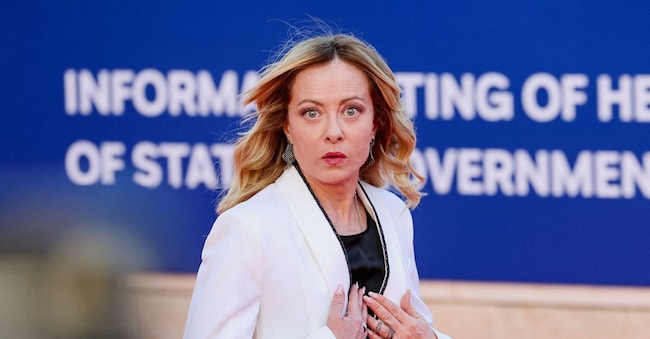
"We need more courage on energy: wasn't keeping inflation at bay a European priority?" Giorgia Meloni has just landed in Cyprus for the working dinner of the Twenty-Seven gathered by the Cypriot presidency in the Informal European Council. She stops with reporters and makes clear Italia's 'determined position': a wake-up call to Europe. Because the energy shock caused by the war in Iran and the closure of Hormuz must be combated with more drastic measures than those put in place with the AccelerateEU package.
"On the energy crisis, a step forward but not enough"
At the press point at the entrance to the afternoon summit in Agia Napa, Meloni is explicit: on the energy crisis 'I think Europe must be much more courageous. I appreciate what the Commission has done with the energy plan, it is a step forward but not enough'. For Meloni, aid to curb the energy price should not be counted towards compliance with the stability pact. 'As is the case for military spending with the Safe loans,' she adds. In the meantime, the prime minister will not stop negotiating with the Commission on an at least temporary suspension of the Ets on thermoelectricity. A point dear to industrialists, but one that clashes with the hostility of President Ursula von der Leyen, the Energy Commissioner and many countries, from the Nordic countries to Spain.
Truck emergency, inflation must be kept at bay
"We have an emergency that is related to road transport," says the premier. "Everyone understands, of course, that when faced with a situation that gets out of hand in that sector we end up with an increase that risks impacting all consumer goods and therefore becomes an inflation problem. So wasn't keeping inflation at bay a priority for the European Union?" Then he punctures: 'We have come here to obviously bring our determined position, not simply to do Italy's interest, which is as always the most important thing for us of all, but to do Europe's interest. Because if we do not respond in time on these issues, it risks doing us a lot of harm'.
Scostamento? "We are not excluding anything"
Meloni, fresh from the bitterness of not having been able to celebrate the sub-3% deficit and therefore the early exit from the European infringement procedure for excessive deficit, obviously has one more problem compared to the less indebted countries: counteracting the energy shock with a very short blanket, little helped by the relaxation of state aid rules. This is why he is not closing the door on the possibility of a budget deviation: 'We have to see what rules we have in the meantime, and then in the coming weeks we will obviously decide how to move nationally, as of today we are not excluding anything. The priority is the answers to the energy crisis, 'but we would prefer to do it in a more comfortable framework'.
The need for flexibility in accounts
The allusion is to the other request that Rome makes to the Twenty-Seven and the Commission precisely in an attempt to avoid the slippage: to relax the rules of the Stability and Growth Pact in order to address priorities. And to do so by unbundling expenditure to counter the effects of price increases. "In my opinion, we need to think more openly, effectively and efficiently. And this also concerns the issue of the Stability Pact. There is talk of State aid in the Commission's proposal, of a flexibility on State aid: it is reasonable and correct, but we know that when we talk about State aid, the fiscal space is not the same for everyone. And so, of course, we have to think about a model whereby these expenses are also not counted'. Already on 22 April in Rome, illustrating the public finance document that had just been approved, the Minister of the Economy Giancarlo Giorgetti urged the introduction of elements of flexibility appropriate to the moment, comparing the holders of the public accounts to 'doctors in the field hospital who see wounded coming in from all sides' while the 'general staff' (the EU summits) have 'different problems'. The premier now raises the issue.


