
Energy, defence, critical raw materials: Meloni strengthens ties with Norway with an eye on the Arctic
Dinner with business leaders this evening. The aim: to strengthen partnerships across all sectors, from underwater to space. Doubts over Von der Leyen’s proposals

Key points
- The focus on critical raw materials
- 'Extended' security at the heart of the meeting
- Industrial partnerships
- Crises and a look at the disputed Arctic
- Consensus on Ukraine
- Russia? ‘Do not respond to provocations’
- Von der Leyen’s proposals ‘to be examined further’
- Schlein speaks of ‘recognition of the Government’s work’
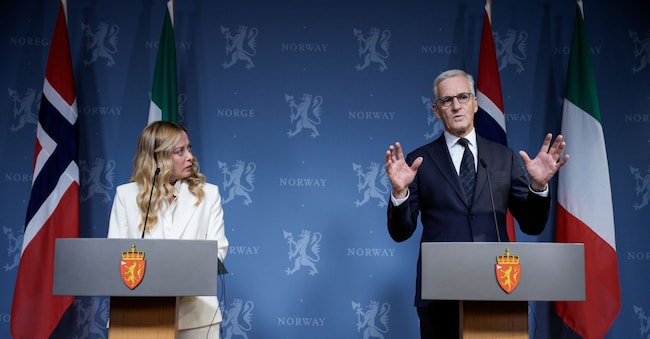
“For us, Norway is a key partner in Europe. It certainly is so because of the role – which everyone is aware of – it plays in diversifying Italy’s energy supplies: it is our fourth-largest gas supplier. But above all, it is so because of the enormous potential that this partnership can realise in other areas as well.” Giorgia Meloni is speaking from Oslo, at the invitation of Prime Minister Jonas Gahr Støre, having arrived there almost 15 years afterthe last visit by an Italian Prime Minister and in the year in which Italia and Norway are celebrating the centenary of the Arctic flight of the airship Norge, carried out in 1926 by an Italian-Norwegian crew led by Umberto Nobile and Roald Amundsen. “I am taking home,” says the Prime Minister, “a comprehensive industrial and strategic partnership, the cornerstone of which is energy but which extends to other areas that are all crucial for security.”
The focus on critical raw materials
The areas to which the Prime Minister refers are ‘advanced technologies, the strategic infrastructure underpinning the transformation of our energy systems, right through to the issue of critical raw materials, which is particularly strategic at this time. The resources available to Norway – I am thinking of the Fen field – open up great opportunities. We want to build supply chains that are shorter, more secure and more resilient to external shocks, thereby also creating our strategic autonomy and opportunities for growth for our peoples’.
'Broader' security at the heart of the meeting
Meloni also sees ‘a great many opportunities’ for the defence industry: ‘We are part of the same Atlantic family; we must build supply chains that will support our broader security needs over the long term’. The same applies to shipbuilding, the submarine sector and space, where – as the Prime Minister points out – ‘our companies have solid and complementary expertise’.
Industrial partnerships
At dinner this evening, companies from the two countries will engage in direct discussions. The aim: ‘To develop untapped potential’. The Prime Minister cited the merger between the Italian firm Saipem and the Norwegian firm Subsea7 as an example: it will lead to the creation of a global giant in energy and offshore services, ‘the second largest in the world’. Støre, for his part, highlighted Eni’s commitment to gas research and exploration in the Arctic, describing it as “a partner with very significant expertise”.
Crises and the focus on the disputed Arctic
The discussion on geopolitics focused on partnerships in Africa and the Arctic, which is increasingly contested by the major powers – the US, Russia and China. “We are two nations,” Meloni asserts, “that are able to see the whole picture. And it is important,” she warns, “at a time like this, when threats – just like opportunities – come from all sides, from every corner.”


