
Energy, Italy's Ges relaunches with manganese batteries
China commissioned the world's largest vanadium flow battery in January
More than 120 large energy storage systems with at least 1 gigawatt of capacity will go into operation worldwide this year, according to industry analysts' forecasts. This is more than double the 50 gigawatts of storage that went into operation in 2025. Most of these projects are taking place in China, which already has 137 gigawatts of stationary storage in operation (of which 58.5 gigawatts is hydro). To compare with the rest of the world, in December alone, China installed 18 gigawatts of mega-batteries, more than the US and Europe have installed in all of 2025. These are mostly lithium-ion batteries (apart from hydro-pumps), but flow batteries are also starting to appear, because lithium discharges too quickly and is not very suitable for long-term storage.
The world's largest vanadium flow battery
At the beginning of January, the world's largest vanadium flow battery with a storage capacity of 1 gigawatt hour and a capacity of 200 megawatts went into operation in Jimusar County, Xinjiang. The system, which is integrated with a 1 gigawatt photovoltaic plant, is the first in the world to reach the gigawatt-hour threshold using flow technology and will allow an additional 230 gigawatt hours of renewable energy to be used each year. In addition to the plant in Jimusar, Rongke Power has already commissioned a 100-megawatt system in Dalian in 2022 and a 175-megawatt system in Wushi, which went into operation in 2024. These dimensions have no equivalent outside China, where the currently operating flow projects are in orders of magnitude smaller. Europe's largest vanadium flow battery is a 2-megawatt plant that is part of Fraunhofer's RedoxWind project, operational since this summer near Karlsruhe.
The manganese alternative
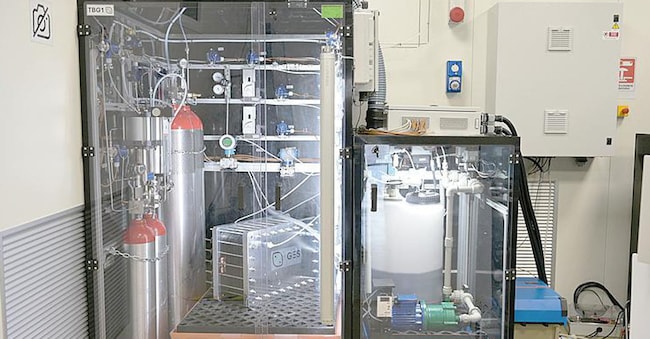
In Italia, the small Green Energy Storage took a different route, choosing manganese as the liquid electrolyte and thus tripling the typical density of a vanadium battery. Its flow battery was unveiled at the end of January in Rovereto after a decade of research, spent on finding an alternative to lithium that met stringent criteria: it had to be a green, inexpensive material, of which there is already a reliable and preferably European production chain. 'Manganese is the twelfth most widespread element in the earth's crust, it is non-toxic (while vanadium is) and is a metal widely used for the production of aluminium alloys and stainless steel, for which there is already a European supply chain, with the associated economies of scale,' explains Ges founder and president Salvatore Pinto. What's more, it has made it possible to achieve a density of around 80 Wh/kg, much higher than batteries using vanadium.
Power/power decoupling
Ges' solution - which has earned itself an Ipcei (Important Projects of Common European Interest) grant of EUR 61.5 million in 2022 - is a flow battery that structurally decouples energy and power. This architecture allows the stack, which is responsible for the power output, and the electrolyte reservoir, which determines the amount of energy that can be stored, to be dimensioned separately. Energy is stored in the form of hydrogen, self-produced within the system and confined in a closed charge/discharge circuit, with no need for external inputs. Compared to vanadium batteries, Ges' technology uses only one reservoir of electrolyte and employs significantly less material for the same amount of stored energy. For this reason, and because of the low cost of the electrolyte, according to the company's calculations, the kilowatt-hour stored and then returned to the system will have a significantly lower average cost than today's dominant technologies in applications above the four-hour cycle duration. Below this threshold, lithium batteries remain more competitive, the costs of which have fallen by 90 per cent over the past ten years and continue to fall at a steady pace.
With the presentation of the prototype, the industrialisation phase now begins for Ges, which is working with partners Manica for the electrolyte chemistry, Rina for the technological validation, De Nora for the testing platforms, and Fraunhofer for the R&D operations. "We will be the European champions of long-life storage," assures Pinto, who foresees the production of the first modules as early as this year and the market debut at the beginning of next year. In Europe, meanwhile, the Chinese dominate: the continent's largest long-life storage system is a 200megawatt/800 megawatt-hour silicon carbide battery from Hefei-based Sungrow, installed last year in Belgium for Engie.

