
Energy price, Lagarde: 'Damaging measures not temporary'. Dombrovskis: 'Limited fiscal space'
With the war in Iran and the closure of the Strait of Hormuz, in Europe 'we are once again facing an energy shock. We must not be distracted by decarbonisation and we must move away from imported fossil fuels," stressed the EU Economy Commissioner when arriving at the informal Eurogroup meeting in Cyprus
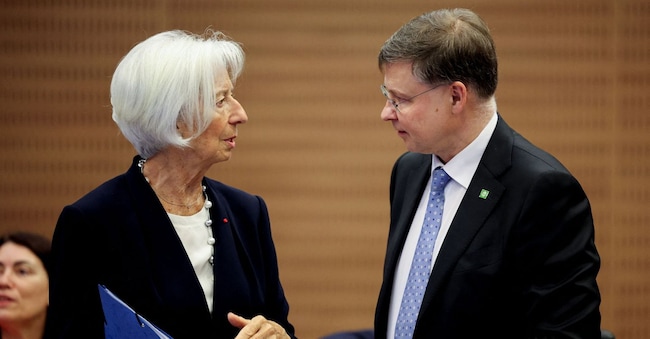
Measures in response to the energy crisis caused by the closure of the Strait of Hormuz must be 'temporary, targeted and calibrated. Any deviation from those principles would actually be harmful and would result in a different orientation in monetary policy'. This was said by ECB President Christine Lagarde at a press conference in Nicosia at the end of the Eurogroup.
"Although the energy crisis is pushing up inflation and weighing on the economy, long-term inflation expectations remain broadly well anchored," Lagarde later clarified to the press. "The implications of this war for medium-term inflation and economic activity will depend on the intensity and duration of the energy price shock and the extent of its indirect effects, as well as second-order effects, to which we pay particular attention," she added.
Lagarde: 'Firm ECB commitment to stabilise prices'
Lagarde then assured that the ECB is 'firmly committed' to ensuring 'price stability' in the euro area. "We are committed to a monetary policy that ensures that inflation" reaches the 2 per cent target, she added, specifying that the ECB will be very "attentive" to "all indicators", including the "anchoring" of inflation expectations. During the Eurogroup meeting, Lagarde continued, "I expressed our firm commitment to price stability, in a context of growing uncertainty resulting from the energy shock, which is certainly a very significant shock, with direct and indirect effects on our economies". "I provided the ministers at the table (the ministers of Germany and France were missing, ed.) with an update on recent developments in economic activity and inflation in the euro area," she continued, "as well as on the latest monetary policy decision we took in April.
Dombrovskis: Member States stick to temporary and targeted measures
Also in line with the position expressed by the ECB president was European Commissioner for the Economy Valdis Dombrovskis. "The European Commission's spring economic forecasts confirm that the energy crisis triggered by the conflict in the Middle East is creating a stagflationary shock for the European economy," explained Dombrovskis upon his arrival at the informal Eurogroup meeting. "We are therefore facing slower economic growth and, at the same time, higher inflation. In terms of policy response, we recommend Member States to stick to temporary and targeted measures, avoiding supporting and increasing demand for fossil fuels, also in view of the limited fiscal space," he reiterated.
With the war in Iran and the closure of the Strait of Hormuz, in Europe 'we are once again facing an energy shock. We must not be distracted by decarbonisation and we must move away from imported fossil fuels,' Dombrovskis went on to emphasise. We must avoid, he repeated, "measures that increase demand for fossil fuels", as we are facing a supply-side shock. Any measures must be 'targeted and temporary', he concluded addressing journalists.

