

Petrolio, la Nigeria si affida alla Cina per il rilancio delle sue raffinerie
dal nostro corrispondente Alberto Magnani

3' min read
3' min read
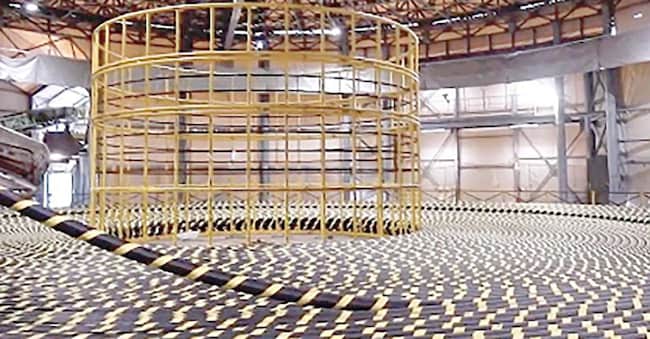
Electricity transmission networks, once static and tied to traditional generation, are becoming increasingly flexible, efficient and capable of supporting the green transition. At the heart of this transformation is Hvdc (High Voltage Direct Current), the direct current technology that allows large quantities of energy to be transported over long distances, reducing losses to a minimum. It is a revolution in which Italian industry plays a leading role, thanks to the leadership of Prysmian, which is changing the rules of the game by laying submarine power lines at ever greater depths. "We are thinking of the world depth record for the installation of submarine cables of the Tyrrhenian Link at 2,150 metres, with which we have set, together with Terna, the new global standard. This is particularly important because it opens up new routes in the deepest areas of the Mediterranean, which were previously off-limits, and puts Italy at the centre of Mediterranean energy connections,' explains Raul Gil, transmission executive vice president of Prysmian. Connected distances are also getting longer and longer, thanks to increasingly sophisticated cable-laying ships, such as Prysmian's latest addition, the 'Monna Lisa', which makes its market debut this spring. To date, Viking Link, between the UK and Denmark, is the longest HVDC cable duct in the world: it comprises 1,400 kilometres of cables, of which 1,250 kilometres are for the submarine route and the rest of land cables on the UK side. Neu Connect, between the UK and Germany, will join it on the podium of the longest power lines in 2027. And many more will follow.
Still in submarine cables, Prysmian is pushing the boundaries of technology with one of its most promising innovations: dynamic cables for floating offshore wind power. The idea is simple and visionary at the same time: while until recently wind farms were restricted to the shallowest seabed, today, thanks to floating turbines, they can be installed in deeper waters, where winds are stronger and more constant. But there is a problem: cables are needed that can withstand the incessant movement of the waves. "The innovation we have achieved with our dynamic cables for floating offshore wind is very important because it increases efficiency and reliability, opening up access to new, windier areas. In Italy, for example, this could offer huge potential around the coasts of Puglia, Sicily and Sardinia,' Gil points out.
The direct current transmission cable revolution also applies to the mainland. State Grid Corporation of China is investing billions of dollars to develop Hvdc projects that will connect the vast renewable resources of western China with coastal cities, and in Germany three large underground electricity corridors are being built to transport the terawatt-hours of offshore wind power produced in the North Sea to consumer centres in the South West. Hitachi Energy is building four large conversion stations for the 'Korridor B', which will transport wind energy from the North of the country to the industrial heart of the Ruhr. And GE Vernova has just opened a specialised Hvdc centre in Berlin.
These innovations are rewriting the rules of the market and speeding up the transition to an increasingly sustainable electricity system, but after the 'accidents' in the Baltic - where on Christmas Day last year the Chinese tanker 'Eagle S' severed the Finland-Estonia Estlink 2 electricity interconnection cable and five other telecommunications cables between Finland and Germany - the issue of safety is becoming increasingly pressing. Monitoring solutions are needed and one of the most interesting innovations comes from Prysmian, which has introduced optical fibres integrated into Hvdc cables to monitor their condition in real time. "We also include optical fibres in our cables for system monitoring and make our expertise available for inspection, maintenance and repair. This is extremely timely and strategic, because the investments being made in this technology today are not only unlocking new forms of much-needed energy, but are making Europe's energy security faster and more efficient,' Gil emphasises. The transmission grid is thus becoming increasingly smart and capable of reporting problems immediately to allow rapid intervention in the event of an emergency. An important point in favour of a technology that not only supports the energy transition, but also opens up great development opportunities for European industry.

