The sale by the Mef of 2.8 per cent

'Eni, the divestment confirms the effectiveness of the strategy'

Group president Giuseppe Zafarana: 'No ideological drifts on transition, placement crowned with great success'

by Celestina Dominelli

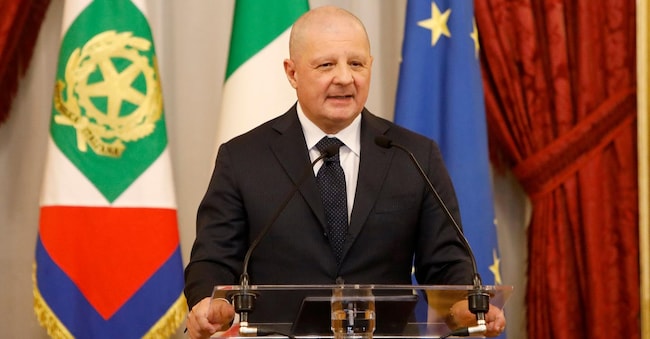
Il presidente dell’Eni Giuseppe Zafarana

5' min read

5' min read

"It has been a particularly intense period because the company is going through a crucial moment, first and foremost for our energy transition path: ten years ago, Eni launched a profound industrial transformation that laid the foundations for the emergence of new transition-related businesses. Now we are in the phase where we go from sowing to harvesting, and we are going through it in a very complex historical and geopolitical context'. One year after his appointment, Eni's chairman Giuseppe Zafarana takes stock of his mandate in this interview with Il Sole 24 Ore, the first granted since he came to the presidency after a long period in the Guardia di Finanza, of which he was also Commander General. He now presides over a group present in 61 countries, with over 33 thousand employees (of which just over 21 thousand in Italy), 'which is going through a very important phase in its history'. And which is always at the centre of investors' appetites, as demonstrated by the Mef's latest move as part of the government's privatisation plan: 'The placement of shares was crowned with great success,' Zafarana observes, 'as had already occurred in other operations, I'm thinking of the recent 30-year bonds. This is further confirmation from the market that we are on the right track'.

Let's start with the geopolitical scenario, which is riddled with new threats. Are you worried?

Loading...

We are more for the humanitarian aspect but not from the point of view of the company's operations, which, using its extraordinary ability to analyse scenarios and synthesise them to translate them into strategic decisions, anticipated events. And this enabled it to stay afloat during the Covid thanks to the streamlining and financial consolidation work carried out over the previous five years. Likewise, the increased focus on gas over the past 10 years proved decisive when the company had to plan for the replacement of Russian supplies with gas from other sources, facilitating the measures initiated by the government.

Many competitors suffered particularly heavy shocks due to sudden changes in the scenario. Has Eni's flexibility, therefore, been providential? .

Absolutely yes, and I am serene because I see a great ability of the company to react in a context in which we operate without certainties. And credit for this must go to CEO Claudio Descalzi, who has demonstrated an extraordinary capacity for vision, excellently supported by his efficient management and the exceptional competence and professionalism of all the people at Eni. People who represent the fertile ground on which to build a future of further great development.

What weight did and does the board of directors that you chair have in this process?

It is playing a fundamental role in supporting the company's CEO and management in managing the complexity of the strategy developed by the company and in monitoring its implementation, helping it to seize the great opportunities offered by the changes taking place and to mitigate their risks. It is a board composed of very professionally prepared personalities: we confront each other, we discuss, it has to be that way, but we always work in great harmony. And the synthesis that comes out always finds its substantial recognition in those who then implement the decisions.

The energy transition is an unavoidable goal, but the trajectory is proving particularly complex and delicate. How do we reconcile the need to hold the target steady with ever-increasing costs and non-linear processes?

Here, too, one can see the far-sightedness of the vision of this group because, when we set out on this path in 2014, it was done with great balance in the sense that we are firmly projected towards the energy transition, but keeping our feet on the ground and being fully aware that fossil fuels - I am referring above all to gas - are still a significant and stable part of the energy demand.

On solutions, however, there has not always been convergence between the states.

We have witnessed and are witnessing many divisions, but we must shun ideological drifts and privileged interests. Because there is no doubt that renewables are an unavoidable solution to be used wherever it is technically possible and economically sustainable, and for this very reason they are a fundamental component of Eni's strategy, but they cannot be a means of excluding any other solution. Everyone must be able to undertake the transition according to the constraints and means at their disposal.

What constraints are you referring to? .

Let me give some concrete examples. Eni is working proactively on CO2 capture and storage, which is criticised by some because it would prolong the life of hydrocarbons. However, it is difficult to think that in the short to medium term we can achieve the decarbonisation of sectors such as the hard-to-abate ones (read: energy-intensive, ed) without this type of solution. Similarly, if we exclude biofuels because we do not consider them carbon neutral, when they currently cut emissions by up to 90 per cent compared to fossil fuels, we are in fact cutting out a fundamental option for decarbonising certain sectors such as heavy, naval and air transport, where electric cannot arrive, and for accompanying the spread of the electric car in light transport with something that already cuts emissions. There is, therefore, no one-size-fits-all solution, but we must use all the technologies at our disposal.

On the energy transition we have seen continuous accelerations and slowdowns in Brussels. Now we are heading towards new elections. What kind of Europe do you expect?

I sincerely hope that Europe will be able to achieve the goals it has set itself on this front too, but I am also convinced that work will have to be done above all on some fundamental elements on which Europe has so far been lacking, starting with governance, whose operating mechanisms need to be refined and made more effective and efficient, also with a view to much faster decision-making. And then there are some major areas on which I would like Europe to achieve real integration, such as foreign policy, defence and tax harmonisation.

Back to Eni's strategy and the satellite model. What is the balance of this piece?

It is proving to be absolutely successful, it was a happy insight that has allowed businesses like Plenitude and Enilive to already create significant value and have important growth targets.

What stage has the divestiture of Agi reached?

We are still in an interlocutory phase. For more than 10 years Eni has been interested in getting out of the publishing business altogether, and over time has collected a number of expressions of interest in the agency, but these have never turned into agreements between the parties. Now this manifestation has been made by a private party (Antonio Angelucci, deputy of the League and publisher of Il Giornale, Libero and Il Tempo, editor's note), which is being evaluated, but we have also publicly declared our willingness to receive and consider other proposals if there are any.

Copyright reserved ©
Loading...

Brand connect

Loading...

Newsletter

Notizie e approfondimenti sugli avvenimenti politici, economici e finanziari.

Iscriviti