
Farewell to Francesco Merloni, protagonist of industry and twice minister
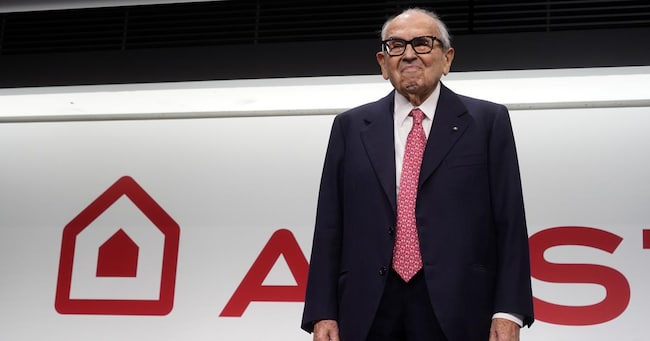
Engineer Francesco Merloni, honorary chairman of Ariston Group, died today at the age of 99 at his home in Fabriano (Ancona)
by Paolo Bricco
2' min read
2' min read
Francesco Merloni died in his bed in Fabriano at the age of ninety-nine - mourned by his family, mourned by his community and loved by his business friends. The son of Aristide, the founder of the Merloni dynasty that literally invented the myth of Third Italy in the Marche region far from everything and capable of building the industrialisation of the Economic Boom from scratch, was first and foremost a man of community. An entrepreneur - with the specialisation of the paternal branch left to him by his father transformed into the model company of Ariston - he chose to unify mechanics and agriculture, favouring the preservation of the peasant roots of his workers, whom the economist Giorgio Fuà called 'metalmezzadri'.
In this, he perfectly followed the lesson of Aristide, his father who was a small Titan of the Italian economy, still shrouded in mystery for his formidable industrial and commercial skills and remembered for his great humanity and solidarity drive. A visionary, Francesco Merloni had the strength - unlike many other second-generation entrepreneurs - to go through the globalisation of the 1990s unscathed, thanks in part to a mechanism of intra-family and managerial delegation that was not merely formalistic, but substantial.
A man of political passion, he has never hidden his vision as a progressive Catholic, eager to hold together the social doctrine of the Church and corporate profit and able, despite the thousand contradictions of our time, to fully grasp the strength of capitalism with a human face that marks - in a thousand provinces and a thousand territories - the Italian model.
Nothing paternalistic. If anything, the idea that it is possible to reconcile the suburb and the world, the places far from the metropolis and the institutional power that resides in large cities. It is no coincidence that Francesco Merloni chose to accept the post of Giuliano Amato, in his first experience in government, and of Carlo Azeglio Ciampi, Prime Minister, as Minister of Public Works, in the crucial years between 1992 and 1994, when Italy - between Mani Pulite, the collapse of the First Republic, the national financial crisis, and attacks by organised crime - was repeatedly on the brink of the abyss.
Industrial engineer, member of parliament in the Christian Democrats in the 1970s (six terms), entrepreneur and author at over ninety of a beautiful book that is also a spiritual testament as 'The Century of Development. Internationalisation and territorial awareness'.


