
Made a plastic that dissolves in the sea in a few hours
The new material developed by a team from the RIKEN Center for Emergent Matter Science and the University of Tokyo

2' min read
2' min read
A group of Japanese researchers has developed a plastic that dissolves in seawater within hours, offering a potential solution to the problem of plastic pollution of the seas.
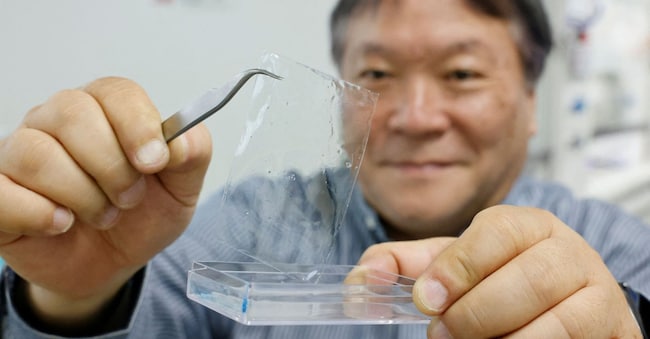
Researchers from the RIKEN Center for Emergent Matter Science and the University of Tokyo claim that their new material decomposes much faster than existing materials, leaving no residual traces. In a laboratory in the city of Wako, near Tokyo, the team demonstrated the disappearance of a small piece of plastic in a container of salt water after it had been shaken for about an hour.
Although the team has not yet prepared any commercialisation plans, the project leader, Takuzo Aida, said that their research has attracted considerable interest, including from those in the packaging industry.
Plastic pollution, a global problem
Scientists around the world are trying to develop innovative solutions to the problem of increasing plastic waste, an effort supported by awareness-raising campaigns such as World Environment Day on 5 June.
The United Nations Environment Programme predicts that plastic pollution will triple by 2040, adding 23-37 million tonnes of waste to the world's oceans each year.

