Good idea

Sustainable by law: fast fashion and the new regulatory framework

A step forward in encouraging more mindful consumption, but also a strategic move to protect domestic industry. Would the French approach to tackling ultra-fast fashion be useful in Italia?

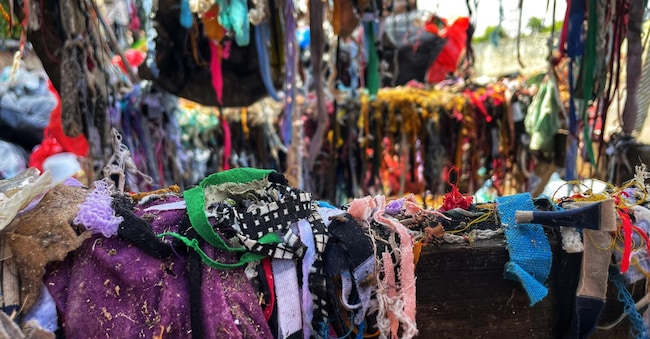
Secondo l’Aea, l’Agenzia europea dell’ambiente, nel vecchio continente produciamo circa16 kg di rifiuti tessili annui a persona, per un totale di 6,94 milioni di tonnellate. ©Getty Images

5' min read

Translated by AI
Versione italiana

5' min read

Translated by AI
Versione italiana

One hundred billion items of clothing are produced worldwide every year, along with 23 billion pairs of shoes. Each French citizen makes 48 new purchases a year, including shoes, clothes and other textile products. The textile industry is responsible for 10 per cent of greenhouse gas emissions; 70 per cent of the world’s clothing is produced from non-recyclable petroleum-based materials such as polyester; China is the world’s leading exporter in the fashion sector, with a share of almost 33 per cent – Italia accounts for 6 per cent, and France 5.7 per cent (figures from the Ministry of Foreign Affairs and International Cooperation); France imports 97 per cent of its clothing.

It makes sense to highlight the figures relating to France because it was in Paris this summer that the Senate passed a law – originally introduced in 2024 – targeting so-called ‘ultra-fast fashion’ produced by Chinese platforms such as Temu and Shein. The aim is to limit environmental damage and extreme competition against European companies, particularly French ones.

Loading...

This measure, which is currently the only one of its kind, forms part of a broader European approach to environmental protection and the curbing of unfair competition. This includes the 2022 EU Strategy, which states that fast fashion is out of fashion and sets out the aim that by 2030 all textile products placed on the market in the EU will be durable, repairable and recyclable. Furthermore, from 1 July, a customs tariff of 3 euros was introduced on small parcels originating from non-EU countries, whilst on 19 July a ban came into force, under the Ecodesign Directive, on large companies destroying unsold clothing and footwear.

The companies to which the French law will apply will be identified on the basis of two cumulative criteria: the number of products placed on the market and the low incentive to repair. If taking a pair of trousers with a torn seam to a tailor costs more than buying a new pair, the choice for the consumer is obvious. The detailed definition of these criteria, however, is deferred to future implementing decrees by the Council of State. The legislation also introduces a tax of between 0.25 and 6 euros (rising to 10 by 2030) on each product and imposes a ban on advertising, including via influencers, who may face a fine of up to 100,000 euros.

The legislative process has been rather bumpy. The left-wing parties abstained from the vote, and their reasoning is simple: after two years of amendments, they say, the final text is much narrower in scope than the original, which targeted not only ultra-fast fashion made in China, but also fast fashion produced in Europe. The current legislation would appear to be driven more by protectionist considerations than by a desire to protect the environment. This view is, of course, shared by environmental organisations. Pierre-François Le Louët, co-chair of the Union Française des Industries Mode & Habillement, who argues that not only can companies that bring some 7,000 new garments onto the market every day not be compared with those that bring out 150, but that the law should be regarded as a first step and a good starting point for the development of potential European legislation.
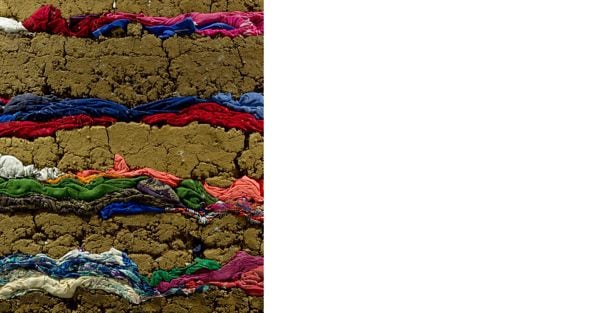
“Sample” (2020) è un’opera fatta di fango e rifiuti tessili di Minga Opazo, artista cilena di stanza a Los Angeles, che esplorala relazione tra cambiamento climatico e produzione tessile. Nelle sue opere, Opazo indaga il concetto di solastalgia, un termine che descrive il disagio mentale ed esistenziale causato dai cambiamenti ambientali e dal vivere in un’epoca di eccessi, di consumo e di spreco.

It is natural to wonder whether a similar law would make sense in Italia. “The context is very different: France imports 97 per cent of the textiles it consumes, so the law essentially affects products from other countries,” explains Milena Prisco, a lawyer and ESG expert in the sustainable fashion sector. “Italian imports, by contrast, stand at 50–60 per cent, and our manufacturing supply chain in the sector is well-structured and strategic. Such a law would be a double-edged sword: on the one hand, it could certainly enhance Italy’s competitive advantage, because targeting the ultra-fast fashion model means rewarding those who produce quality, and Italia’s textile manufacturing excellence is based on the values of durability, reparability and circularity set out in the EU Textiles Strategy. On the other hand, however, that part of our industry operating in the mid-to-low price segments could be penalised by overly rigid criteria. The most desirable scenario is for Italia to play an active role in shaping European rules – the Ecodesign Regulation and the Textile EPR are already being implemented – rather than proceeding independently, at the risk of creating a national regulatory framework that is out of step with the EU’s.”

It must be said that, beyond the political and legal implications, the French law gives rise to reflections of a general, almost philosophical nature. According to Benoît Heilbrunn, lecturer in Branding, Design and Consumer Behaviour at ESCP Business School in Paris, the legislation alters our relationship with an important freedom: the freedom of choice. ‘For the first time, a state is not concerned with protecting consumers by ensuring they can make informed and, above all, free choices: by stipulating that certain market practices are unacceptable, it is safeguarding a new and collective principle – that of the world’s liveability.’ According to Heilbrunn, the strength of brands such as Shein lies in their ability to resolve a cultural contradiction. Today, in fact, consumers are faced with a vast array of products and ever-diminishing purchasing power. Ultra-fast fashion allows them to participate in the capitalist mechanism of acceleration at minimal cost. ‘It is no coincidence that, unlike traditional brands, these platforms do not create a brand image: they rely entirely on consumers’ freedom of choice and self-expression,’ he explains. The lecturer does not believe in the distinction between fast fashion and ultra-fast fashion. ‘The fashion industry has always been based on a principle of seasonality, which has been undermined by the invention of Black Friday; from that point on, a process of progressive acceleration began that must be condemned regardless of the number of garments released onto the market each day,’ he explains. ‘The platforms will certainly find ways to circumvent the law, which nonetheless has great symbolic significance, because it generally establishes that the time has come to set limits and return to the principle of garment durability. Governments can support and encourage this change: on the one hand, through tax systems that ensure quality textile products are affordable; on the other, by promoting information campaigns that explain to consumers how the notion of cheap products is a myth, because whilst purchasing them guarantees immediate satisfaction, in the long term it is financially detrimental’. In short, for a paradigm shift to take place, environmental awareness alone is not enough: we must ensure that consumers clearly perceive the benefit. This is the challenge for the future, and whilst Paris has pointed the way, it is Brussels that will have to chart the course.

Copyright reserved ©
Loading...
Loading...

Newsletter

Notizie e approfondimenti sugli avvenimenti politici, economici e finanziari.

Iscriviti