
Enzo Bianchi: for the Word and against idolatry

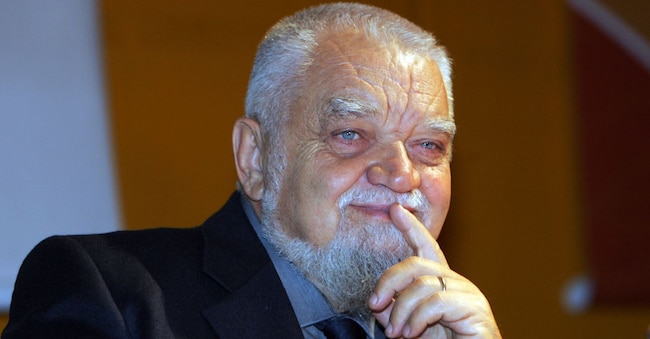
‘Idolatry, idolatry!’ It was a phrase that Enzo Bianchi – who died yesterday in Turin at the age of 83 – often repeated. He uttered it with the sudden vehemence of a peasant prophet. His light-coloured eyes would shine even brighter, his voice would sound more clucking than usual, and a tremor of impatience would ruffle his beard. In the Bible, he explained, the opposite of faith is not unbelief, nor, much less, atheism. What challenges the glory of the Most High is the impure worship reserved for idols: the golden calf that the people of Israel fashioned with their own hands, imitating the idols of the pagans; or the idols of modernity, of which Francis Bacon provides a list in his Novum Organum that remains relevant to this day.
To renounce idols and place his trust solely in the God of Scripture, at the age of 22 Enzo Bianchi had withdrawn to the farmhouse at Bose, in the countryside around Biella. Prior to that, his life story can be summarised in a few key stages: his birth on 3 March 1943 in Castel Boglione, in the province of Asti; his diploma in bookkeeping; then his degree in Economics in Turin; and his discovery of Christianity not as a doctrine to be passively accepted, but as a tradition to be carried forward in a generous and creative way. These were the years of the Second Vatican Council; there was an increasing emphasis on ecumenism, and Bianchi soon became passionate about the idea of a Church without borders – renewed through the sharing of charisms across different denominations and capable of bridging the gap with Judaism. No, to say he became passionate is an understatement. Like the rich young man in the parable, Bianchi – who was not rich – renounced everything and devoted himself to the Word. To set the record straight – first and foremost with himself – he decided to begin his life as a hermit on 8 December 1965, the very day on which the Council solemnly drew to a close. In the early 1990s, Bianchi would reflect on the meaning and implications of that act in *i* *Ricominciare. Nell’anima, nella Chiesa, nel mondo* , a book written in conversation with the philosopher Mario Guzzi and still in print from Marietti 1820. Not exactly an autobiography, but undoubtedly a first-hand account of the significance that the Bose experience quickly came to take on. The first companions arrived in 1968, a year that was fateful in every respect. In a short space of time, the community took on the form we still recognise today: as well as being ecumenical, it is both male and female, dedicated to manual labour and cultural enrichment, as demonstrated, amongst other things, by the activities of the Qiqajon publishing house. If not a scandal (though there were certainly those willing to take offence even back then, and, if they so wished, they could easily find cause for offence even now), it was certainly a welcome anomaly.
Enzo Bianchi of Bose remained prior until 2017, when the most painful and controversial chapter of his personal life – and of the monastic community itself – unfolded. It was a series of events that many found difficult to comprehend, not least because, by that time, Bianchi had come to occupy a position of unquestionable importance. As a key interlocutor in dialogue with the Eastern Churches (a role recognised even by John Paul II), he had become a constant presence in Italian and international cultural debate. With a touch of irony, he admitted that his numerous books were now divided into two categories: works intended primarily for believers and therefore published by Catholic publishers, first and foremost San Paolo, and those aimed at a wider audience, which one might hastily describe as ‘secular’. Here, the publisher of choice was Einaudi, with whom highly successful titles such as La differenza cristiana (2006) and Il pane di ieri (2008), as well as La sapienza de cuore, a collection of essays compiled in 2013 to mark his 70th birthday. In 2022, it was once again Einaudi that brought to bookshops the new translation of the Bible conceived by Bianchi and edited by Mario Cucca, Federico Giuntoli and Ludwig Monti. ‘Today,’ he wrote in the preface, ‘we can say that the Bible is the library that does not divide, does not separate, does not give rise to fundamentalism; it calls for the affirmation of diversity, of plurality and therefore of dialogue, because it is structurally dialogical!’ Everything else is idolatry.

