Welfare

Equal parental leave: what it is and why it was rejected

The proposal of 5 paid months for both parents rejected due to high costs and technical remarks by the State Accounting Department

by Rome Editorial Staff

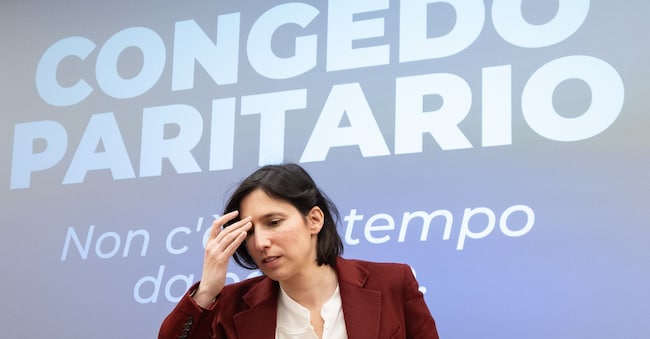
La segretria PD Elly Schlein in occasione della conferenza stampa a seguito del rinvio della proposta di legge sul congedo paritario. Camera dei Deputati, Roma Martedì 24 Febbraio 2026 (foto Mauro Scrobogna /LaPresse)  Democratic Party Secretary Elly Schlein at the press conference following the postponement of the bill on equal parental leave. Chamber of Deputies Rome, Tuesday February 24 2026 (Photo by Mauro Scrobogna / LaPresse)

4' min read

Translated by AI
Versione italiana

4' min read

Translated by AI
Versione italiana

The equal parental leave is a protection model that aims to equalise the rights and duties of mothers and fathers in caring for their children, overcoming the traditional distinction between maternity leave (longer and compulsory) and paternity leave.

The most recent versions of the bill supported by the oppositions in the House (first signatory was PD secretary, Elly Schlein) provided for a five-month leave for each parent with guaranteed pay of 100 per cent of salary (compared to the current system with percentages varying between 80 per cent and 30 per cent).

Loading...

According to the proponents, the period would also become mandatory for fathers, exceeding the current 10 days provided by law. With non-transferability: the months accruing to one parent cannot be transferred to the other.

The vote of the Chamber of Montecitorio

The Chamber of Deputies has rejected all the articles of the oppositions' bill on equal maternity leave for mothers and fathers. In particular, the assembly approved a series of suppressive amendments tabled by the Budget Committee following findings on financial coverage. With the deletion of all articles, the measure was rejected without being able to proceed either to consideration of the agendas or to the final vote.

Reason for stop

'The coverage is inadequate'. So says a passage in the technical report of the State General Accounting Office on the draft law on equal leave. The Ragioneria's document refers to the technical report transmitted by the Ministry of Labour and Social Policies on the bill. On Article 1 of the pdl, it is pointed out that 'the technical report, relating only to the charges for those registered with INPS, quantifies them, assuming they take effect from 1 January 2026, at EUR 520.8 million for the year 2026 progressively increasing up to EUR 636.6 million per year starting from 2035. These burdens are, however, underestimated because they do not include the burdens relating to female freelance workers who are members of the relevant social security funds'.

With regard to Article 2, that on equal leave, 'the technical report quantifies the costs, assuming they come into effect as of 1 January 2026, at €3,179.9 million for the year 2026 progressively increasing to €3,875.2 million per year as of 2035. Overall, the technical report quantifies the total costs arising from Articles 1 and 2, assuming they come into effect as from 1 January 2026, at €3,700.7 million for the year 2026 progressively increasing up to €4,511.8 million per year as from 2035.

The Ragioneria also points out the need for additions, as 'detailed information is required on the personnel concerned who are employees of the public sector and, in particular, those belonging to the school sector'.

Lastly, 'Article 4 of the measure indicates the burdens in the amount of EUR 3 billion per year starting from 2025, to be borne from expenditure savings and higher revenues resulting from the reshaping and elimination of environmentally harmful subsidies (Sad). Considering that the measure provides for a timeframe of charges relating to a financial year that has now ended, it is pointed out that it results in charges of an increasing and structural nature, higher than those indicated'. Hence, the conclusions: inadequate coverage, 'insofar as formulated in merely programmatic terms referring to the remodulation or elimination of unspecified measures in order to meet certain and quantified charges'.

The political back-and-forth

"You are entrenching yourselves today behind a technical excuse, that there is a lack of coverage, but you know that it is only a question of political will because you found it to make the bridge over the Strait of Messina, to make empty prisons in Albania, then you are hypocrites and it is not the first time that you have chosen to compress the spaces of our opposition and our united proposals. You did it even on the minimum wage'. This was said by Elly Schlein in the Chamber of Montecitorio during the vote that caused the measure to fall.

For the PD secretary, the majority 'has scuttled a concrete proposal that could improve the lives of millions of Italian families, an equal leave, five months paid at 100 per cent for both parents, would also cover female workers and the self-employed'. The rapporteur of the text in the Labour Committee, Marta Schifone (FdI), rejects the accusations. 'The family and the birth rate are at the centre of the political agenda of the Meloni government and Fratelli d'Italia. The technical report of the State General Accounting Office is clear: the coverage of the bill on parental leave of the oppositions is inadequate and the measure 'cannot be positively verified'. It is not a political question, it is a question of responsibility towards the keeping of public accounts and towards Italian families'. And, he stressed: 'Presenting proposals without adequate coverage is not protecting families: it is making propaganda on their skin. We continue to work seriously and with facts, as we have always done'.

Copyright reserved ©

Brand connect

Loading...

Newsletter

Notizie e approfondimenti sugli avvenimenti politici, economici e finanziari.

Iscriviti