
Eritrea, a burning beauty
‘Everything We Haven’t Seen’, by Tommaso Giartosio, tells the story of the Horn of Africa whilst reflecting on the very possibility of recounting it and on our responsibilities as former colonisers

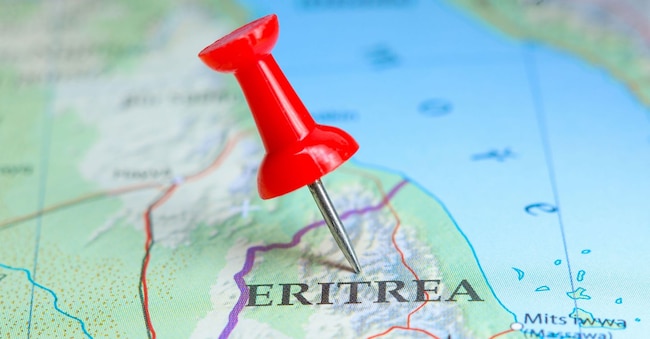
‘What is a travelogue? In my view, it is the experience of the non-expert: a definition that encapsulates both its strength and its limitation. As a layman who has merely read a few books, I can only recount what I have seen (heard, touched, eaten). My perspective is not unfiltered; on the contrary, it is coloured by countless subjective prejudices and objective limitations, not to mention outright censorship. Yet this perspective is a real event; a fallacious image has taken on a provisional completeness.” Tommaso Giartosio, poet, writer and radio presenter, recounts Eritrea whilst simultaneously reflecting, in a meta-literary way, on the very possibility of recounting it. In Everything We Haven’t Seen, eloquent right from the title, he seeks out its beauty (with highly evocative descriptions) and also ponders an honest and conscious way of describing it, as well as engaging, as a tourist, with a country that was an Italian colony for 50 years before passing briefly to the British and then to the Ethiopians, and sinking into a war that lasted half a century. What struck him most of all was the expanse, both terrestrial and celestial: ‘I realised that what I had seen was not the Milky Way. Now the true Galaxy had risen. It stretched from one end of the sky to the other, in all its writhing like a smoking intestine of lights… (...) The truth is that that thing – that sheer vastness – left me speechless, or rather, the words I had at my disposal simply didn’t do it justice. How could there be room for it and for us? How can such a crushing triumph of indifferent nature make me feel fully human?’ Space, and the effect it had on his perception of himself, exerted a magnetic pull on the author from the very first moment, when, looking out from the aeroplane bound for Asmara, he observed ‘the unbridgeable indigo of the night outside; the spotlights inside, one per seat’. And it also became a narrative thread. The constant juxtaposition between the infinite and the finite, and also between the objective and the subjective, between history and the present, between lyrical fervour and a return to everyday banality, permeates the entire narrative. Thanks to Giartosio’s ability to hold these opposites together dialectically, without distorting them, the journey to Eritrea – one of the places of our guilt, never atoned for nor even understood – also becomes an opportunity to spur us on to think in ethically ambitious terms, to shake off the mediocrity, the ‘deafness’, into which we have shut ourselves away, without this degenerating into illusion or, conversely, into self-absolution (‘And the more I learnt about the history of this country – which even the most ardent isolationist would have had to admit, in one way or another, unquestionably concerned us – the more I was stirred by a confused sense of guilt and solidarity: confused, as if even in solidarity there were something culpably reductive. The Eritrean victims of colonial and post-colonial wars, of oppressive regimes and desperate flights, weighed heavily upon me’). Significant, in this sense, is the clarity that accompanies the description of the moment when the author and the photographers with whom he had set out – having witnessed the country’s extreme poverty, the brutality of the dictatorship and the toxic legacy of colonisation – arrive at the Dahlak Islands, ‘an archipelago of hundreds of sparkling little islands’, and here, immersed in the deep, luminous blues, whites, light blues and turquoises, are overwhelmed by a euphoria of childish play. ‘The allure, for all of us, was too strong. The Western archetype of the perfect island, the Eden where we could transform ourselves into the noble savage (…). We were not innocent (who is?), but we were staging our own rhetoric of innocence. Never were we more ourselves than in that half-hour of abandon: lost in the illusion that belonged to us most of all, just as a shaman sinks into his trance. And our bodies, marked by all the frailties and follies of the West – the ‘sun-kissed’ sun-kissed complexions, our artificial nails, our pasta-fed bellies and our catalogue-chosen tattoos – that afternoon, they were ridiculous, childish and glorious bodies’. Equally significant is the painful reflection on the difficulties of bridging the gap between the Italian and the Eritrean, the chasm that both attracts and repels the privileged and the oppressed, the unattainable friendship – because it is, by definition, gratuitous – between the little girl dying of thirst in the desert and the wary cloud, to use the metaphor from the heart-wrenching short story by a brilliant yet still underappreciated Eritrean-Ethiopian writer, Saleh Addonia (in She Is Another Country , Casagrande, 2018, recently published in English, with new stories: The Feeling House, Holland House, £10). It is even complicated to play together, partly because, as Giartosio writes, ‘play hinges on dominance; it brings it into play—that is, it simultaneously evokes and suspends it; it is both training and repression, and for this reason it gives us pleasure, unless the dominance is too palpable, to the point of revealing itself as a real and overwhelming privilege; for in that case, the game goes into overdrive and risks veering off towards something else, something real and violent’.
© ALL RIGHTS RESERVED
Tommaso Giartosio, *Everything We Haven’t Seen: A Journey Through Eritrea*, Einaudi, 184 pages, €18

