
Ertè, protagonist of the shining era of the Arts Dèco
An exhibition celebrates him at Franco Maria Ricci's Labirinto della Masone in Fontanellato
Director John Cox recounted how he was shocked by the workmanship of Ertè (born Romain de Tirtoff) when, after long attempts, he managed to secure his collaboration for a history-making edition of Richard Strauss's 1980 Der Rosenkavalier at the Glyndebourne Festival, starring a radiant Felicity Lott and the charming Rachel Yakar. The artist (who was part of a wave coming from Russia, primarily linked to the lesson of the Ballets Russes) was in his eighties, but as throughout his existence he continued to draw, paint, and work in every sphere of the applied arts, including fashion and theatre. It was in this dimension that he always left important marks, from his early youth. Arriving in Paris, despite the opposition of his family of military descent, who did not believe that the scion's career as a tailor was acceptable, he immediately joined the glittering world of Paul Poiret, recently celebrated by a major exhibition at the Musée des Arts Deco in Paris.
Here he designed costumes for the famous music magazine Le Minaret and dressed Mata Hari, inaugurating collaboration with a long string of stage divas. An important exhibition, the first in Italia after many years, which bears the subtitle Style is everything, curated by Valerio Terraroli (catalogue edited by him, with an essay by Alessandra Tiddia, Franco Maria Ricci, pp. 157, € 68) at Franco Maria Ricci's Labirinto della Masone in Fontanellato, on view until 28 June, re-proposes the work of the man who Diane Vreeland, his great supporter since the 1920s, in a famous 1979 documentary, in dialogue with Ertè, defines him as the protagonist of the dazzling era of the Arts Dèco, then leaving the artist to speak.
New York
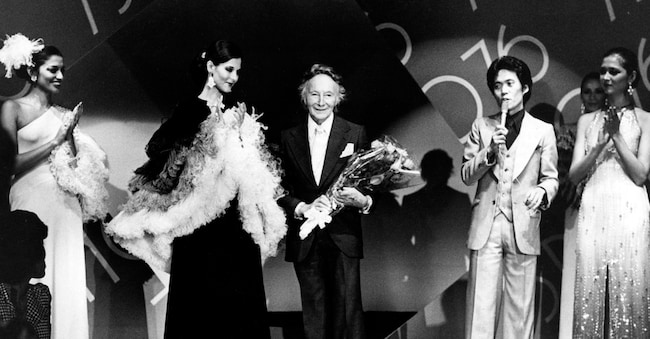
Franco Maria Ricci, portrayed with him, had discovered his art in New York, sought him out in Paris and dedicated a book to him in 1970, which is now a bibliographical rarity, asking Roland Barthes to write the introductory essay. His works were often quoted and revisited; in Horst's exhibition at the Cini Foundation, the alphabet women stand out as an obvious homage. The exhibition traces the collaborations with some divas who turned to the master of costume design for their shows. Ganna Walska, Polish by birth and American by adoption, made a name for herself for a lack of vocal talent (Orson Welles apparently referred to her when defining the character of the protagonist's wife in Citizen Kane) and for an amazing ability to marry very rich spouses who rented theatres in Paris and Chicago. Magnificent are the figurines on display for Rigoletto (with a clear reference to Beardsley) and for Fedora. Also noteworthy are the works for Zizi Jeanmaire, a music hall star, in Paris in the 1970s, including La veuve rusée from the 1971 show Zizi, je t'aime. At that time, the famous singer Cathy Berberian, abandoning the rigours of the avant-garde, had also turned to the Russian master for the costume of À la recherche de la musique perdue, a sensational excursion into the world of salon romance in the late 19th and early 20th century. Some of the most complex stage designs are related to the famous Scandals, invented by impresario George White, which was very important for Ertè's arrival and fame in the United States, where for many years he played a leading role in the pages of Harper's Bazaar.
Stunning are the river figurines (The sources of the Rhine, Guadalquivir) for a 1923 production. These fabulous productions ceased with the great crisis of 1929, when the artist, who had found his great fortune in the USA, left the country, returning to France, where he became indelibly linked to the Folies Bergère scene. Francis Poulenc turned to him, calling him 'magician', in 1947, for the staging of the premiere of Les mamelles de Tyresias, an admirable work, a metaphysical comedy, based on the play of the same name by Guillaume Apollinaire. Critics have often associated Ertè's work with the world of the Ballets Russes, and especially with the decisive lesson of Leon Bakst, but the master has always preferred to point out a lineage for the use of full colour given to wide backgrounds, for choices of representation that play with two-dimensionality, the Persian miniature. Magnificently on show is a set design for the Sheherazade episode for Aladin at the Folies Bergère in 1929. There is no shortage of oriental subjects, including a Ali Baba, costumes for the Mother of Pearl ballet in Marseille in 1923, which staged the secrets and splendours of Indochina. Also of great importance are the designs for fashion, starting with work done in 1913 under the aegis of Paul Poiret, from whom he later distanced himself, inaugurating his own venture, which was thwarted by the master. Dresses, shoes, parasols, corsets, bustiers, hairstyles, scroll by testifying to the amazing talent of the Russian master, who left an enormous body of work.

