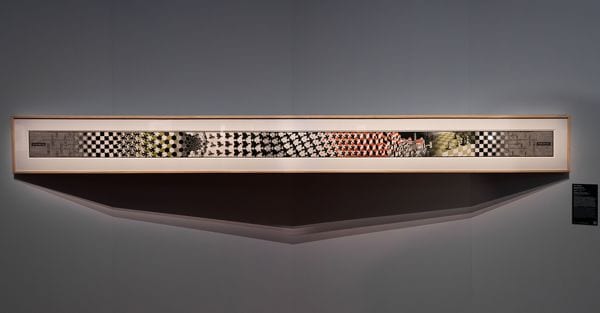
Escher: a major exhibition for the genius of perspective distortion and paradox
The exhibition at Mudec analyses the central role of science, Islamic art, representations of the infinite and Italian landscapes in the Dutch artist's poetics

3' min read
3' min read
Mysterious, almost mysterious, his great poetry as a challenge to himself and the canon. With the Sonnet en X, Stephane Mallarmé takes his art to unusual heights, at the same time experimenting with forms and structures that would forever connote free verse. And so while visiting the exhibition, and what an exhibition, dedicated by Milan's Mudec to Maurits Cornelis Escher, I thought back to the great and complex French poet. Because forms, structure, vision, contamination and experimentation come into play, in the wonderful game, of this artist, as it was also for the supreme symbolist in his time. Because Escher, too, was clearly an artist well beyond the schemes, capable of revisiting Islamic art, marked by figurative iconoclasm, finding in mathematics and crystallography as in the exact sciences, in perspective geometry and even in optical illusion matter to be reshaped at will along the difficult lines of engraving art and a highly personal poetics.
Federico Giudiceandrea, coordinator of the exhibition's scientific committee
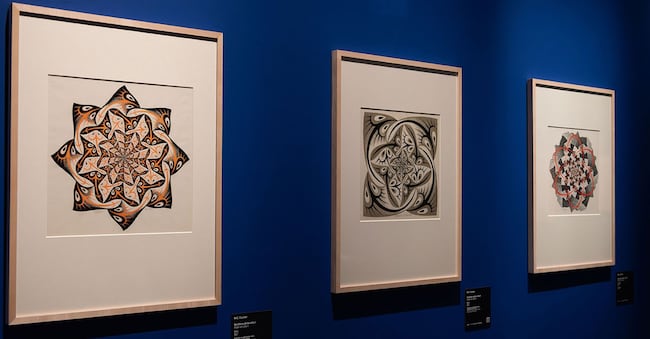
Federico Giudiceandrea, coordinator of the exhibition's scientific committee, explains how the trip to Granada with "The Alhambra is considered a watershed in Escher's artistic life, a kind of revelation. There, Escher himself was enchanted by the technique that the Arabs used to embellish their palaces, since they could not depict human figures, animated figures, they used geometric motifs, and precisely in order to fill their walls anyway, these artists tessellated the plan. Escher filled a whole notebook with the drawings he had made at the Alhambra. Back in Holland, his brother, who was a professor of geology at the University of Leiden, a crystallographer, revealed to him that these techniques were actually studied by mathematicians and that there had been eminent mathematical crystallographers who had shown that there were only 17 different ways to tessellate the plane. Escher, also fascinated by this mathematical aspect that Islamic art had within it, began to experiment, to make these drawings, but unlike the Arabs, instead of using geometric elements, he tried his hand at animated figures, with fish, with birds. And it is a very difficult technique, because each stroke has two meanings: the lower part of the bird is at the same time the upper part of the fish (as in"Regular division of the plane with birds and fish", coloured pencil, 1938, ed.) and this is precisely a strong constraint that Escher gives himself in making these drawings, a little like in poetry, there is rhyme or in music the canons of harmony. A strong constraint that by trying and trying again gives birth to his art,' Giudiceandrea continues.
Professor look, talking about Escher's art, there are two fundamental elements that you have highlighted. Certainly the horror vacui and also the constraints that this artist sets for himself in his poetics. Shall we explain them?
"In being a graphic artist and engraver Esher imposes a very strong constraint; he only uses the pure sign, he never crosses lines.
It is not that he imitates what painting is, he just uses graphic art in an absolutely pure way by making only lines and only the thickness of these lines makes the figure stand out and this is another very strong constraint that Escher experienced from the beginning when he was in Italy, that is, all Italian landscapes are made with this technique.