Justice and employment

Eternit-bis: the Court of Cassation orders a fresh appeal for Schmidheiny

The charges relating to the deaths of 25 of the victims have been time-barred. The appeal trial will concern around sixty further deaths attributed to exposure to asbestos

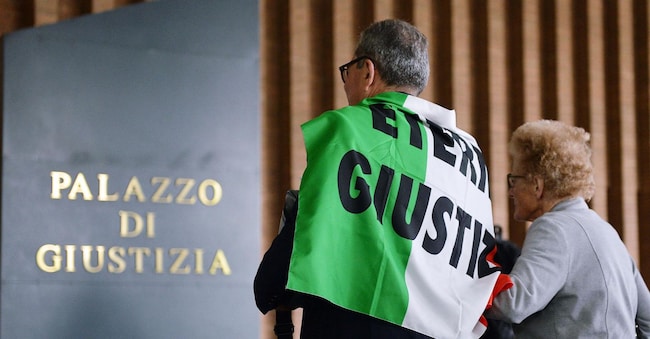
Familiars of the victims during the first preliminar audience of Eternit second case, where the only accused is swiss entrepreneur Stephan Schmidheiny, at Justice Palace in Turin, 12 May 2015.  ANSA/ ALESSANDRO DI MARCO ANSA

5' min read

Translated by AI
Versione italiana

5' min read

Translated by AI
Versione italiana

There is to be a new appeal trial for former tycoon Stephan Schmidheiny in connection with the Eternit case. This is the decision of the Court of Cassation, which has also ruled that the statute of limitations applies in relation to the deaths of 25 people. The new appeal hearing will, however, concern some sixty other deaths recorded as a result of asbestos pollution. The Attorney General’s Office had sought confirmation of the defendant’s sentence of nine years and six months, in relation to the charge of multiple counts of aggravated manslaughter for the deaths of 91 people in Casalese. In the view of the Attorney General of the Court of Cassation in the proceedings relating to the Eternit case, in fact, “the procedural issues raised by the defence are unfounded,” said the Attorney General before the judges of the Fourth Section. ‘The judgement of the Turin Court of Assizes of Appeal is well-reasoned and provides procedural protection for the right to life,’ the Public Prosecutor added, requesting that the defence’s appeal be declared inadmissible.

Decision following 6 hours of deliberation

The Supreme Court’s ruling on the Eternit case and the charges against businessman Stephan Schmidheiny came after more than 6 hours of deliberation. The president of the Fourth Section read out the judgement in a courtroom packed with relatives of the victims, who remained in complete silence. The verdict will refer the case of the so-called ‘killer factory’ in Casale Monferrato back to another section of the Turin Court of Appeal for a fresh assessment. The proceedings will concern around 60 people who died as a result of asbestos pollution and mesothelioma. For a further 25, the statute of limitations has been definitively applied; this, together with the failure to establish criminal liability on the part of Schmidheiny, represents a substantial victory for the defence lawyers, who, just over a year ago, had succeeded in having the proceedings set aside because the second-instance judgement had not been translated into German. Stephan Schmidheiny had managed the Eternit factory in Casale from 1976 to 1986.

Loading...

The Association of Families of Asbestos Victims before the Court of Cassation

The judges of the Court of Cassation have re-examined the matter, following the quashing of the first appeal proceedings due to the failure to translate into German the judgement by which the Turin judges had convicted the businessman for the deaths caused by asbestos in Casale Monferrato, a town in the province of Alessandria. Schmidheiny managed the Eternit plant for ten years, from 1976 to 1986. The tycoon is charged with multiple counts of aggravated manslaughter in connection with the deaths of 91 people. For a further 300 victims, the charges had been dropped following acquittals and the expiry of the limitation period in the lower courts. A delegation from the Association of Families of Asbestos Victims (Afeva) in Casale Monferrato was also present at the Court of Cassation. A banner bearing the words “Justice – Research – Remediation” was displayed in Piazza Cavour.

The former deputy mayor: people are still dying in Casale

“People are still dying in Casale Monferrato. Almost 50 people a year. So far, there have been 3,000 victims.” This is what Gianni Crisafulli, former deputy mayor of the Piedmontese town where the Eternit factory was in operation until a few years ago, said this morning. Together with a large delegation of citizens, he is outside the Court of Cassation this morning for the trial of the company’s former owner, Stephan Schmidheiny.

“My father,” said Crisafulli, “died of mesothelioma, even though he didn’t work for the company. In this trial alone, the number of victims stands at 330 citizens and 62 former workers. “We are talking about defenceless people, citizens who unwittingly lost their lives because of the use of asbestos.” Many people this morning are wearing the symbol of Afeva, the Association of Families and Victims of Asbestos, around their necks.

“I hope there will be some justice for my mum, who was killed twice: by asbestos and by the statute of limitations,” says a woman waving a small Italian flag. “Last time we came home empty-handed. Because of a technicality,” adds another resident of Casale, “it took another few months for the appeal judgement to be translated into German.”

Under the law, the limitation period for manslaughter is set at 15 years from the victim’s death and continues to run even whilst legal proceedings are ongoing. “What happened in Casale Monferrato could set a precedent for all similar cases, in Italia and across Europe,” explains Crisafulli. “We need justice; we need a proper verdict.” The decision is not the one hoped for by the victims’ families, who will have to wait a little longer.

Outside the ‘Palazzaccio’, people are now struggling to hide their bewilderment at the Supreme Court’s decision. ‘We need to understand, we need to understand,’ they say.

The lawyer representing the civil party

 “We are reading the judgements; if necessary, I will appeal them. It is certainly a huge disappointment, especially for the victims and for me too. Our frustration stems from once again failing to bring justice to this tragedy.” These were the words of Giacomo Mattalia, the lawyer representing the civil claimants, as he left the Court of Cassation following the ruling ordering a new appeal trial in the Eternit case.

The lawyer, explaining the Supreme Court’s decision, added: “For the majority of cases, the court has ordered a quashing with a remand, and so the appeal proceedings will be held again. Then there is a second group of cases where the proceedings were quashed without a retrial because the statute of limitations had expired. And then there are two further cases involving workers, where the statute of limitations expired during the proceedings, and in which the defendant’s appeal was dismissed, but only in respect of the civil aspects.”

Loading...

The former Eternit worker

“Time will pass and other cases will become time-barred; this is justice that slips away, a true injustice.” So said Nicola Pondrano a former Eternit worker from Casale Monferrato following the Supreme Court’s ruling ordering a new appeal trial for the Swiss businessman Stephan Schmidheiny in the case relating to asbestos-related deaths in the Casale area. “For the majority of cases, the judgement has been quashed with a remand, so the appeal trial will be held again,” explained Giacomo Mattalia, the lawyer representing the civil claimants. “Then there is a second group of cases where the judgement has been quashed without a remand because the statute of limitations has expired. And then there are two further cases involving workers, which became time-barred during the proceedings, for which the defendant’s appeal was dismissed, but solely in respect of the civil claims.” “It is a huge disappointment, especially for the victims and for me too. Our frustration stems from once again failing to secure justice in this tragic case,” emphasised the criminal lawyer.

Mesothelioma patient: I won’t live to see the end of the trial

“My name is Elena and I was born and brought up in Casale Monferrato. In August 2025, I was diagnosed with mesothelioma and it was recognised as having been caused by occupational exposure. I urge you to do one thing: to see for yourselves the reality of the outpatient clinics. In Alessandria, they see between 48 and 50 new patients a year, which means that every year there is almost one new asbestos-related patient every week”. These were the words of one of the residents of Casale Monferrato who waited outside the Court of Cassation for the Supreme Court’s ruling on the Eternit trial.

Elena then added: “Unfortunately, we victims are getting younger and younger. After the chemotherapy, the removal of the pleura and other treatments, I asked the doctor if I could consider myself cured. Her reply was that you never really recover from this disease. The average life expectancy for a patient is 18 months, who knows if we’ll ever live to see the end of this story”. Elena then explained: “I understand that the courts must establish a causal link, but what is the causal link, other than the hospitals and the death statistics in our area?”

Copyright reserved ©
Loading...

Brand connect

Loading...

Newsletter

Notizie e approfondimenti sugli avvenimenti politici, economici e finanziari.

Iscriviti