
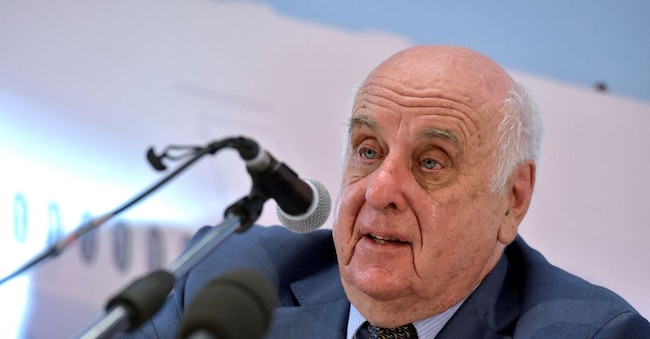
Étienne Davignon, architect of European industrial policy
Every time he arrived in Brussels, Henry Kissinger asked his government interlocutors who welcomed him the same question: "Where is Davignon?", ignoring protocols and hierarchies and seeking directly the opinion that interested him. And indeed, remembering him today, in the days following his death, the figure of a great exponent of the best Europeanism emerges.
by Gian Paolo Manzella, Vice President, SVIMEZ Dimitri Zurstrassen, Researcher specialising in European industrial policy, LUISS Guido Carli and Bocconi
 Aggiungi Il Sole 24 Ore
ai preferiti su Google
Every time he arrived in Brussels, Henry Kissinger asked his government interlocutors who welcomed him the same question: "Where is Davignon?", ignoring protocols and hierarchies and seeking directly the opinion that interested him. And indeed, remembering him today, in the days following his death, the figure of a great exponent of the best Europeanism emerges.
A Belgian diplomat, Etienne Davignon was between 1964 and 1969 head of cabinet to Foreign Minister Paul-Henri Spaak - one of the founding fathers of the European Community and one of the main architects of the Treaty of Rome - and later to Pierre Harmel. Those were the years - it was the time of Le défi américain - in which he came into contact with the first Community industrial policy projects, in a geo-economic context characterised by a growing awareness of the American technological challenge and the industrial rise of Japan. His involvement in European affairs would be even deeper in the following decade. After chairing the Executive Committee of the International Energy Agency, he was appointed European Commissioner for Industrial Affairs in 1977, becoming Vice-President in the Thorn Commission in 1981.
Those were the years in which he invented the so-called 'Davignon method': building coalitions between Member States, industrial actors and trade unions to translate European strategic objectives into concrete action. A pragmatism in which the social dimension was constitutive: suffice it to say that the Davignon Plan for the steel industry, adopted on the basis of the ECSC Treaty to deal with an extremely serious crisis - mass closures, hundreds of thousands of jobs lost, entire territories affected - provided for reconversion measures for workers and aid to the regions. Restructuring of industry and support for the territories were, in short, to go hand in hand.
And if this of the close relationship between competitiveness and cohesion is the first of Davignon's legacies that should be emphasised, the second is that of the ability to anticipate scenarios. One need only think of the field of information technology, where the Belgian statesman's vision reveals all its relevance. His 1979 communication to the European summit in Dublin outlined, with extraordinary lucidity, a precise diagnosis: there was a structural backwardness of Europe in microelectronics and an inadequacy of the Community's industrial policy instruments in the face of the corresponding American and Japanese public support programmes. But, alongside the diagnosis, there were precise steps. First of all, the definition of the goal of increasing Europe's share of the world semiconductor market from 13 to 30 per cent. Under Davignon's impetus, a proposal for 'European preference' in public technology procurement was then defined, with the aim of preventing the European market from ending up benefiting only foreign competitors; there was the definition of various research programmes in the 1980s, among which ESPRIT should be mentioned; finally, there was a great deal of attention to the issue of access to credit, with the development of new Community financial instruments drawn up in collaboration with the French Commissioner François-Xavier Ortoli.
It was a commitment to support industry that was to continue over the years. Even in 1997, when chairing the panel evaluating the R&D framework programmes, he concluded that the framework programme lacked strategic orientation and called for a 'new qualitative leap'. An observation that resonates with what the Draghi Report says today: Europe is lagging behind in cutting-edge technologies, with programmes that need to be more strategically selected; with a public procurement system insufficiently oriented towards Europe's strategic industries; with financial instruments still insufficiently mobilised towards breakthrough innovation.

