
ETS: ‘Loss of up to 892 million in annual revenue at EU transhipment ports’
A study by Assarmatori quantifies the damage caused by the European measure: ‘Up to 3.6 billion less in investment in ports’

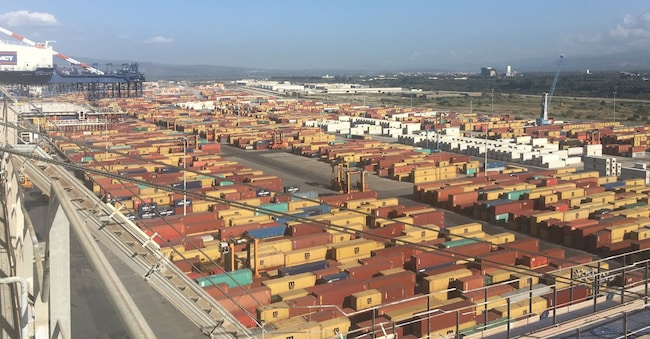
The introduction of the European ETS taxation system for maritime transport is causing an already visible shift in transhipment activities (the transfer of containers from larger ships to smaller feeder vessels) outside Europe, particularly to Africa, with potential losses for EU ports amounting to as much as €892 million in annual revenue and up to €3.6 billion in port investments. The alarm has been raised by Assarmatori, which presented a study on the issue in Brussels during the workshop EU ETS Maritime: Safeguarding European Transhipment, hosted by MEP Letizia Moratti, a study on the issue carried out by Giovanni Satta, associate professor in the Department of Economics at the University of Genoa.
The report covered 22 ports across Europe, with a particular focus on the hubs at Gioia Tauro, Taranto, Marsaxlokk (Malta) and Sines (Portugal). According to analyses carried out by Tim 10, under the supervision of Satta, the short-term scenarios predict, over a five-year period, the transfer of between 7.5 per cent and 15 per cent of the volumes exposed to risk, corresponding to between 2.85 and 6.3 million TEUs (a unit of measurement equivalent to a 20-foot container) being transferred; with a loss ranging from 403 to 892 million euros in associated annual revenue; as well as the loss of between 1.43 and 3.6 billion euros in equivalent investment in the capacity required to handle those volumes. This situation results in the loss of activity (due to these volumes being channelled elsewhere) linked to between 2,005 and 4,431 annual jobs.
The study goes on to state that transhipment ‘is particularly sensitive to differences in operating costs between competing hubs. Unlike traffic destined for the local market, it can easily be transferred between alternative ports within the same international network. Once shipping services and investments in terminals move outside Europe, it becomes virtually impossible to win them back.”
The report emphasises that scientific evidence ‘has shown the inadequacy of anti-circumvention measures. These provisions may counteract evasive stopovers, but not the transfer of transhipment operations outside the EU, which allows goods bound for non-European markets to avoid routes subject to the EU ETS, whilst maintaining links with Europe via feeder services. Tightening the restrictions already in force – the study argues – without a complementary measure to incentivise transhipment in Europe would therefore not eliminate the economic asymmetry underlying this relocation’.
‘The relocation of transhipment operations “to Africa” – says Alberto Rossi, General Secretary of Assarmatori – carries the very real risk of turning the continent into a new strategic hub from a logistical and geopolitical perspective. Rather than a strategic hub of limited geographical scope, such as Suez or Bab el-Mandeb, Africa is becoming a bottleneck and a source of significant strategic dependence for global supply chains.”


