
Ettore Scola: his connection with Rome on display at Palazzo Braschi
A journey through life and filmmaking in the exhibition entitled “Ettore Scola – We Never Parted”

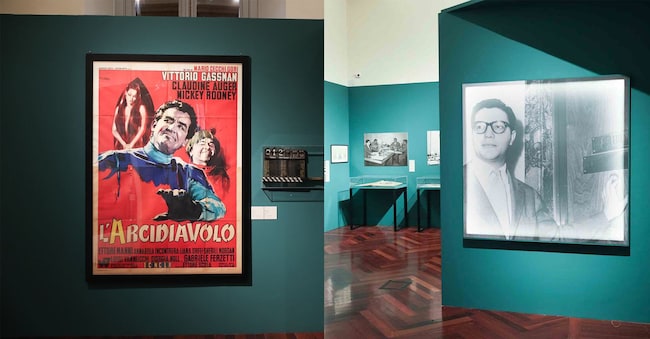
The man, the artist, his connection with Rome: amongst the drawings for *Marc’Aurelio*, the screenplays that gave rise to masterpieces, the posters and images from unforgettable films, a story unfolds that goes beyond the narrative of Italian cinema, reflecting on and exploring, with Ettore Scola’s characteristic depth and irony, the history of a country. To mark the tenth anniversary of his death, Roma Capitale is dedicating the exhibition “Ettore Scola. We Never Parted” to the great director; it can be visited until 13 September at the Museo di Roma in Palazzo Braschi.
Irony
An exhibition that reflects the artist’s distinctive ability to blend reflection and drama with comedy, to synthesise the complex and the popular, and to tell ‘The’ story through individual stories. And so, in this exhibition curated by the director’s daughter, Silvia Scola, and by Alessandro Nicosia, irony and an ability to interpret reality are evident in the strokes of the drawings and in the screenplays which, within the exhibition – organised in collaboration with Marco Scola Di Mambro, the author’s grandson and curator of the family archive – from which much of the material originates, as well as from the Luce Archive, Rai Teche and the Studio EL – Cinecittà S.p.A. Collection – almost envelop the visitor, conveying a complete picture of the grandeur of his art.
The screenwriter, the illustrator and the director
And then his transition to film directing: the images that evoke masterpieces, the sketches (such as that of the iconic corridor in *La famiglia*) that capture atmospheres and emotions, the posters, the objects, the writings. All this serves to convey the care that went into creating something that is more than just a film: ‘His cinema continues to tell us a great deal about our lives and our illusions,’ emphasises director Roberto Andò in the notes accompanying the exhibition. It is a way of looking not only at his work and his films, but also at life itself, with that commitment which lies at the heart of the legacy of great Italian cinema. From *We All Loved Each Other So Much* to *Ugly, Dirty and Bad*, to *A Special Day*: the ability to depict changes and eras whilst, at the same time, still speaking to everyone.
Commitment and art come together: and this initiative, alongside and prior to the filmmaker – the winner of numerous awards and four-time Oscar nominee – sketches a portrait of the man (as highlighted by the first of the three sections into which the exhibition is divided, which traces the early years of Ettore Scola, born in Trevico, who then came of age in southern Italia and Rome). Then comes the artist, with the second section examining the various facets and stages of his career, the screenwriter, the illustrator and the director, whilst also focusing on some of the most important figures in his story, from Sordi to Fellini – to whom he dedicated *Che strano chiamarsi Federico*, whose poster features prominently in the exhibition, alongside the trench coat he wore in *We All Loved Each Other So Much* – Gassman, Mastroianni, Troisi and Trovajoli. Meanwhile, his relationship with the capital is the theme of the third section: Rome as the protagonist, Rome at the heart of so many of his films (from the aforementioned “C’eravamo tanto amati” to “La terrazza”), a connection that can also be (re)discovered through an interactive exhibition.
A journey through life and filmmaking, traced in this exhibition through a visual narrative brought to life by photographs, film footage, manuscripts and personal belongings, displayed alongside iconic and evocative professional artefacts – such as the director’s chairs, clapperboards or the typewriter – which become a story in their own right.

