
EU moves towards a 5G network for emergency communications and first response
An integrated system will link the emergency services of at least 12 Member States by 2030, improving coordination and the emergency response
from our correspondent Beda Romano
 Aggiungi Il Sole 24 Ore
ai preferiti su Google
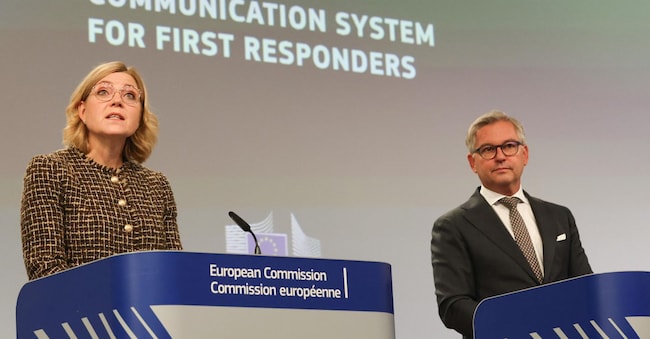
BRUSSELS – The European Commission today, Wednesday 30 September, presented a new system for intra-European communication to be used in all first-response and emergency situations. With this in mind, Member States will be required to transition from radio systems to 5G technologies. The European Commission’s proposal also provides for the establishment of a cyber risk monitoring centre, tasked with coordinating the response of Member States.
“We want to ensure that our first responders have the tools they need to share vital data, coordinate instructions in real time and work together across borders,” explained Henna Virkkunen, Vice-President of the European Commission. Magnus Brunner, Commissioner for Home Affairs, added: “In collaboration with a number of European companies, we have developed a Europe-wide solution, reducing our dependence on foreign technology.”
At present, emergency services across the country are unable to communicate with one another. The European Commission wants to enable them to remain in constant contact, with the aim of responding more effectively not only to natural disasters (such as fires or floods), but also to cyber threats, the presence of drones or in the event of terrorist attacks. The new network will be a broadband network, with the option of also using satellite communications.
At a press conference, Vice-President Virkkunen explained that the new communications system is expected to be up and running by 2030, initially connecting a dozen Member States (“Some countries may collaborate even sooner,” she pointed out). Full implementation is scheduled for 2036. “The new network will be for Europe and made in Europe,” emphasised Commissioner Brunner. A pilot project is already underway, involving four European industrial groups.
“The new system,” explains the European Commission in the documentation distributed to the press – will cover the entire territory of the European Union as well as the countries associated with the Schengen Area. The system will cover all emergency services: law enforcement, the fire service, civil protection and emergency medical personnel. Member States will be able to add further users, in particular the armed forces, at their discretion.”


