
EU and China together stronger at the negotiating table with the US
The US is experiencing incredible instability with knock-on effects on the world economy and yet domestic demand cannot be met entirely by domestic production

4' min read
4' min read
The European Union has very good cards to play at the negotiating table with the United States in the trade war opened by the Trump administration, but it must do so in a united spirit. The US is experiencing a moment of incredible instability with knock-on effects on the world economy and yet domestic demand cannot be met entirely by domestic production, the consequences on inflation are already visible and this is an important strength of European countries. Another advantage is investment in the US, more than 60 per cent of which is foreign. Moreover, Washington needs the rest of the world to buy up its steadily growing debt. The negotiation imposed by Donald Trump ultimately concerns precisely the purchase of debt. If the EU finally manages to enter into closer cooperation with China, the cards to be played will increase in the negotiations imposed from overseas.
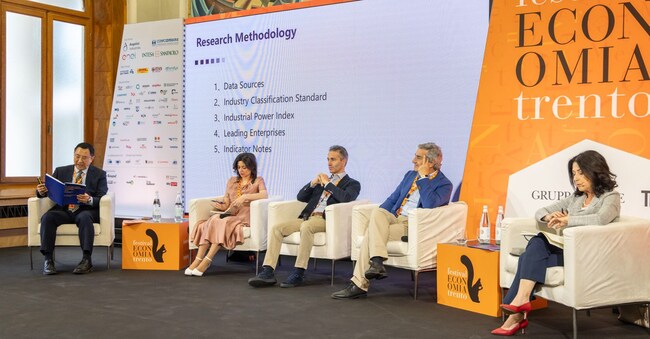
These are the conclusions that emerged from the panel 'The global industrial situation and cooperation between the USA, China and Europe' held during the Trento Festival of Economics, attended by Stefania Di Bartolomeo, ceo of Physis Investment, an American fintech specialising in sustainability; He Zhiyi, professor of the Institute for Global Industry at Tsinghua University; Lorenzo Stanca, managing partner of Mindful Capital, a private equity fund manager focused mainly on small and medium-sized Italian companies; and Paolo Lazzarini, chief strategy and business development officer of Amplifon, the Italian company world leader in hearing solutions.
The global industrial landscape now sees the EU as the third industrial powerhouse, after the US and China, according to Professor He's research, conducted from 2016 to 2024 on 48,000 listed companies from 117 countries worldwide. The survey came up with an Industrial Power Index capable of surpassing the GDP indicator to take into account the complexity of today's global competition. "The study highlights the fact that the European Union, as a single economy, is the third power globally," He stressed. If in fact among the world's top ten countries in the Industrial Power Index (based on capitalisation, turnover, profits of the companies analysed) are the United States, China, Japan, India, the United Kingdom, France, Germany, Canada, Korea and Switzerland, when looking at the EU as a bloc, the index puts it in third place. Furthermore, among the European countries, the top four powers are France, Germany, the Netherlands and Italy.
Cooperation between the EU and China takes on greater weight in this scenario, Lorenzo Stanca points out. The strong opening experienced from 2000 onwards, with Beijing's entry into the WTO, was however followed by a slowdown in exports and investments after 2012, with the arrival of Xi Jinping. At the same time, the weight of the United States increased. Until 2 April this year, when Trump's announcement on tariffs threw the future of exports into uncertainty. And not only that. Meanwhile, Stanca emphasises, other components on the world chessboard, for example sub-Saharan Africa, are growing and may continue to grow. The real crux, however, is the non-substitutability of the US market. This 'obscurantist approach' of the US will have a recessionary effect that worries all operators, Stanca comments.
Amplifon's Paolo Lazzarini expresses the hope that the US attitude will change. "Our key markets," he says, "are Europe, the United States, Australia and China, even in the current international context from which we are not particularly impacted. We are not a manufacturer, we are a retailer: we therefore have the possibility of having the best technologies on the market, sourcing from manufacturers who in turn use supply chain diversification strategies. Furthermore, to date hearing aids, as essential medical devices, have been exempt from duties under specific international agreements. The growth of our presence in the US, organically and through acquisitions, is crucial for us as they are the world's leading market in our sector, while China is a very interesting market, especially in view of demographic trends".


