
The EU and Ukraine: between progress and tensions; the Irish Presidency gets underway with Zelensky
The president, who was in Dublin yesterday, hopes to open a further five chapters of accession negotiations ‘soon’. Against this backdrop are the ups and downs in relations with Poland and Hungary, and the cloud of suspicion hanging over an Irish company’s exports to Russia
from our correspondent Beda Romano
 Aggiungi Il Sole 24 Ore
ai preferiti su Google
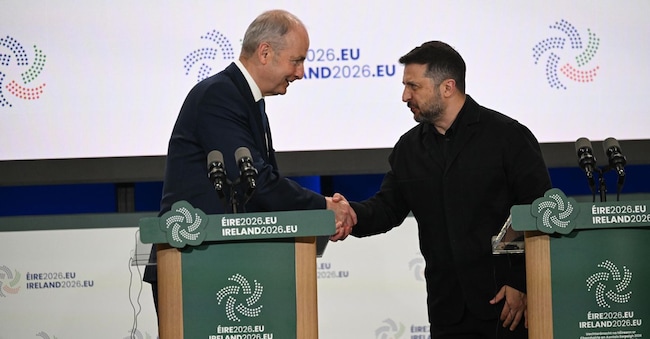
DUBLIN – Volodymyr Zelensky’s presence has become a regular feature at major European institutional events, particularly at ceremonies marking the start of the EU’s rotating presidency. Following Aarhus in July 2025 and Nicosia in January this year, the Ukrainian president was also present in Dublin yesterday. Formally, Ukraine is now part of the wider EU family – although beneath the surface, tensions are far from absent.
In June, the EU-27 decided to open the first chapter of accession negotiations for both Ukraine and Moldova. In a speech yesterday marking the start of the Irish Presidency of the EU, President Zelensky expressed his hope that a further five negotiation chapters could be opened ‘soon’. Speaking of his hopes regarding accession, the Ukrainian leader emphasised, addressing the more sceptical European partners: “It is so important to keep one’s promises.”
President Zelensky then went on to highlight his country’s role: ‘Without Ukraine, without its experience and expertise in defence (…), it is simply impossible to guarantee security today, particularly with regard to air defence and maritime security; which is why I call on the whole of Europe to cooperate as closely as possible’. At stake in the cooperation between Kyiv and Brussels are the production of new drones and an anti-ballistic programme.
Micheál Martin, the Irish Prime Minister, has promised that Dublin will work “towards opening all the negotiation chapters (33 in total, ed.) by the end of our six-month term”. The situation, however, is delicate. Kyiv’s relations with Poland and Hungary have been marked by ups and downs. Tensions with Warsaw centre on Ukraine’s decision to name a military unit ‘Heroes of the UPA’, in memory of an ultra-nationalist group from the Second World War accused of killing thousands of Poles. With Budapest, on the other hand, the sticking point remains the treatment of the Hungarian minority in Ukraine.
One of the sources of friction between Kyiv and its European partners is the presence in Ireland, in County Limerick, of Europe’s largest alumina refinery. Owned by the Russian group Rusal, the Aughinish Alumina plant reportedly exports more than half of its output to Russia, where the material – according to an investigation by the Swedish authorities revealed by the Irish newspaper the Irish Times – is also used in the arms industry.


