
EU Council gives green light to Albania model: the plan's expenses, stops and controversies
The government aims to re-launch the Albania model after the green light from the EU Home Affairs Council on the clampdown on the return of irregular migrants, which provides for the simplification and acceleration of return procedures and allows member states to set up hubs in third states

Key points
The plan for the migrant centres in Albania, strongly desired by Prime Minister Giorgia Meloni, has remained an unfinished project for now. Large resources spent, few effective repatriations and strong political contrasts with the judges' rulings that have repeatedly suspended its operation. The government aims to relaunch it with the new European regulatory framework and the go-ahead given by the EU Council of Internal Affairs to the tightening of the return of irregular immigrants, which provides for the simplification and acceleration of return procedures and allows member states to set up hubs in third countries. In fact, it clears the Albania model as designed in the Italian government's original project, i.e. as a structure to outsource and speed up the examination of applications for international protection and the repatriation of migrants picked up at sea while trying to reach Italian shores.
The Gjader centre used only as a CPR
Initial forecasts were high with 3,000 persons per month to be detained, with a very high turnover, up to a maximum of 36,000 per year. The aim was to apply the accelerated border procedures for the examination of asylum applications, but since last April the Gjader facility has only functioned as a Retention Centre for Repatriation (CPR). Since then, only a few hundred migrants have passed through. Repatriations have also been limited, only a few dozen.
Cost of one billion in five years
Small numbers so far, therefore, compared to far more ambitious initial plans for a project costing almost one billion euros over five years.
The structures set up
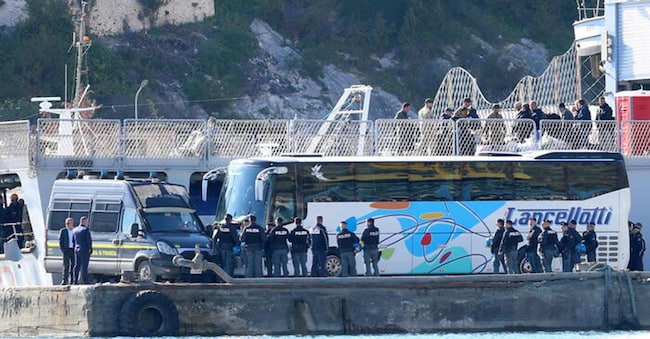
Three different facilities have been set up on the site - at Italian expense: the largest is a centre for asylum seekers with 880 places, then a CPR with 144 and a penitentiary with 20. A hotspot was set up in the port of Schengjin. There - on board an Italian military ship - migrants intercepted in the central Mediterranean were supposed to arrive. But all attempted transfers turned out to be a flop because the detentions in Gjader were not validated by the judges of the Court and then the Court of Appeal in Rome. This was due to the impossibility of recognising so far Egypt or Bangladesh as safe countries of origin for repatriation purposes. Countries that the EU Internal Affairs Council has instead considered should be included in the list of safe countries.
The unknowns
In August, a ruling by the European Court of Justice ruled that a government can designate a third country as safe by decree-law, but only if that choice can be submitted to a judge. And, until the entry into force of the new EU regulation as part of the Migration Pact on 12 June 2026, no country can be considered safe if it does not guarantee protection for its entire population. In recent weeks, the Appeal Judges in Rome referred a new question on the protocol between Rome and Tirana to the EU Court of Justice for a preliminary ruling. The subject of the appeal is related to whether Italy could sign the agreement on the Albanian centres in light of the fact that asylum is largely regulated at EU level. It will now be seen whether the go-ahead for the European Pact on Immigration and Asylum will be enough to overcome the magistrates' stops and to make the structures work at full capacity as insistently promised by Prime Minister Giorgia Meloni

