Justice

EU Court: Political parties cannot use well-known trade marks without ‘just cause’

The case concerns the use of the Ikea logo by a Flemish political party. Fundamental rights of equal standing are at stake: property rights and freedom of expression.

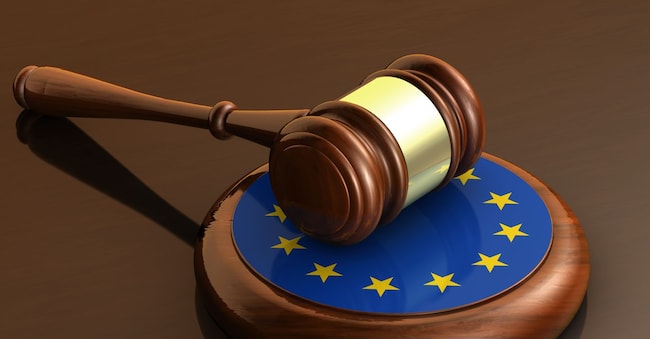
European Union laws, legal system and parliament concept with a 3d render of a gavel on a wooden desktop and the EU flag.

3' min read

Translated by AI
Versione italiana

3' min read

Translated by AI
Versione italiana

Can one capitalise on the reputation of a well-known international brand, such as Ikea, to reinforce one’s political message, by invoking freedom of expression? The judgment of the Court of Justice of the European Union in Case C-298/23, published yesterday, Tuesday 8 September, answers this question in essentially the negative.

The story

The story begins in 2022, in Belgium, when the political party Vlaams Belang, part of the Flemish far-right, presented its political programme entitled ‘IKEA-PLAN – Immigratie Kan Echt Anders’ (‘IKEA Plan – Immigration Can Really Be Different’), which aimed to reform the country’s asylum and immigration policy. The policy proposals were accompanied by a number of illustrations featuring symbols resembling the IKEA logo and characters similar to those appearing in the assembly instructions for products from the Swedish company.

Loading...

Inter Ikea, the owner of the trademarks featured in the political programme, therefore brought legal proceedings in Belgium for trademark infringement against the Vrijheidsfonds association, which had run the Vlaams Belang party’s campaign.

The Belgian judge

Before the national court, the defence team representing the Vrijheidsfonds association oscillated between admission and ‘just cause’; in other words, they acknowledged having used the Ikea trademarks without the consent of the proprietor, but argued that they had drawn on the renown of these logos to reinforce their own message. The underlying argument is that this constitutes ‘just cause’ under European Union law, which protects freedom of expression, including the freedom to express political opinions and engage in political parody. The relevant legal provisions in this regard are Article 9(2)(c) of Regulation (EU) 2017/1001 of the European Parliament and of the Council on the EU trade mark, and Article 10(2), (c) and paragraph 6 of EU Directive 2015/2436 of the European Parliament and of the Council on the approximation of the laws of the Member States relating to trade marks.

The Belgian judge, having concluded that he was dealing with a case in which there is a conflict between fundamental rights of equal standing – property and freedom of expressionreferred the matter to the Court of Justice of the European Union.

The Court of Justice of the European Union

Firstly, the Court observes that EU law does not contain any clarification regarding the concept of ‘just cause’. Although the legislator has emphasised that the legislation must be applied in such a way as to ensure respect for fundamental rights and freedoms, a mere reference to the right to freedom of expression is not sufficient to demonstrate a valid reason. Indeed, anyone who uses a sign that is identical or similar to a well-known trade mark must explain the specific reasons for its use for the purposes of their freedom of expression and demonstrate that these reasons take precedence over the rights and interests of the trade mark proprietor.

The national court is therefore required to determine whether a third party’s use of the world-renowned trade mark took place in good faith. Some factors to be taken into account are:

  • use intended to convey an idea or opinion relating to the trade mark as such, to the proprietor of that trade mark, to its commercial practices, to its goods or to its services;
  • the use of the trade mark which contributes to a debate of general interest;
  • the consequences that the use of the trade mark may have for the proprietor, if, for example, it causes him disadvantage that is disproportionate or, indeed, such as to undermine the very substance of the exclusive right guaranteed by the trade mark registration.

Furthermore, the case in question is also linked to the possibility that the association of the trade mark with a political programme might give rise, amongst consumers and the general public, the presumption that the trade mark proprietor – in this case, therefore, Inter Ikea – endorses or even supports the ideas and values promoted by the political group in question, namely Vlaams Belang.

The conclusion

In its judgment in Case C-298/23, the Court of Justice of the European Union therefore states that the use of the Ikea trade marks may cause significant damage to their reputation and to the interests of their proprietor. However, it does not appear that the use of the Ikea trade marks by the Vrijheidsfonds association, with a view to capitalising on their reputation and, consequently, reinforcing its own political message and increasing its reach, takes precedence over the rights and interests of the trade mark proprietor. This matter must be assessed by the referring court.

Copyright reserved ©
Loading...

Brand connect

Loading...

Newsletter

Notizie e approfondimenti sugli avvenimenti politici, economici e finanziari.

Iscriviti