
EU defence funds, why Crosetto is pressing Giorgetti
Rome must confirm to Brussels by the end of this month whether it intends to make use of the Safe programme. The communication must be made by the Minister of the Economy

Key points
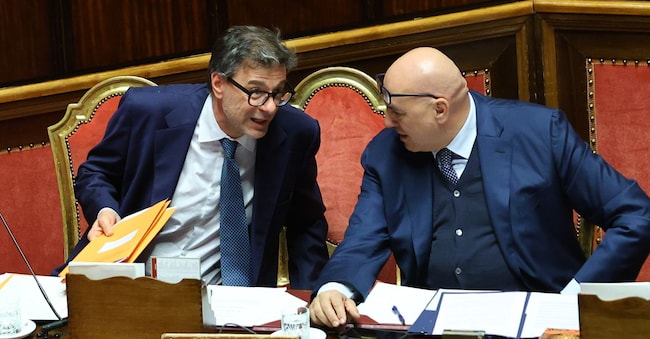
It is a tug-of-war over the defence funds put on the table by the European Union that sees two ministers of the Meloni government as protagonists in these hours. On the one side is Guido Crosetto, the FdI exponent, and on the other is Giancarlo Giorgetti (League), the Economy Minister. On Thursday 14 May, Crosetto said he had written twice to the Treasury urging a decision on the possibility of drawing on the EU fund for the purchase of weapons (the Safe, Security Action for Europe, the instrument supported by the EU budget and fielded by Brussels to strengthen defence capabilities and achieve the military spending objectives agreed at NATO), adding that Rome must confirm by the end of this month whether it intends to avail itself of the programme. In short, the Defence chief is pressing his colleague who has the final word on spending decisions that impact on public accounts. Updating national defence equipment - also to meet the commitment made at NATO - is Crosetto's priority. In recent months there have been several meetings, at various levels, with other European partners interested in the programme.
The node of resources to cover the energy price
But for the government, as Prime Minister Giorgia Meloni has repeatedly said and Giorgetti himself reiterated no more than two days ago at question time in the Chamber of Deputies, the most urgent one is the answer to the energy price. On which a particularly complicated negotiation is underway with Brussels precisely in order to exploit the flexibility margins currently designed for defence and security. Rome is asking for these margins to be extended, at least in part, to cope with price increases, first and foremost fuel prices.
Giorgetti: Safe is still a loan
The Minister of the Economy, however, after Crosetto let it be known that he had written to him 'twice' and was waiting for 'an answer' as to whether he would be able to sign the new investment contracts at the end of May, officially did not react. But just on Wednesday 13 May, again at question time, he had reminded us that even Safe is still a loan. 'A financing system certainly not at zero cost,' were his words. And even if it has 'the advantage of allowing a deferment in time and advantageous rates', he added, it still implies 'the obligation of repayment'. Among other things, 'almost all of the spending programmes' that Italia plans to finance with Safe 'concern contracts that already exist and are still being implemented,' the Mef holder explained.
The joint loan programme financed by the EU budget
Safe is a joint loan programme financed by the EU budget to boost the Union's defence capabilities and help member states achieve more ambitious NATO spending targets. Last year, Rome was among several countries that applied to the European Commission for loans, which would allow the government to finance planned spending at a lower interest rate than it would pay on the market. Brussels has recognised 14.9 billion from 2026 to 2030 of the total 150 for 'accelerating defence readiness. "The choice whether or not to access the Safe fund must be made by the end of May, as contracts must be signed by then," Crosetto explained on the sidelines of an event for the launch of a digital platform aimed at companies, large and small, that intend to collaborate with the ministry. Crosetto added that he was "neither pessimistic nor optimistic" about the final decision.
Italy's commitment
Italia pledged more than EUR 12 billion to increase defence spending by 0.5 per cent of GDP until 2028, triggering protests from opposition parties that the money would be better spent on struggling public services. Italia's continuation in the infringement procedure for excessive deficit, decided by the European Commission, has effectively reduced the space available for budgetary policy, according to the principles defined in the 'corrective arm' of the Stability and Growth Pact. In practice, recourse to new deficits is precluded (at least on paper), and access to the national safeguard clause to decouple defence expenditure, amounting to some 12 billion over three years, from the deficit calculation is not allowed. An option used so far by 17 member states. It is up to PM Meloni to find a political synthesis on defence spending. Meanwhile, former prime minister Mario Draghi sounded yet another wake-up call for Europe and from Aachen urged the 27 to act. "For the first time in living memory we are truly alone, together," was the ultimate message sent to the continent's leaders. Europe should make 'binding commitments' on 'mutual defence', as dependence on the US in this field is no longer sustainable.


