Towards Europe

EU Defence, Michel: there is a will to align means and ambitions

The President of the European Council outlines the priorities of the next legislature and the steps towards a new defence fund

3' min read

3' min read

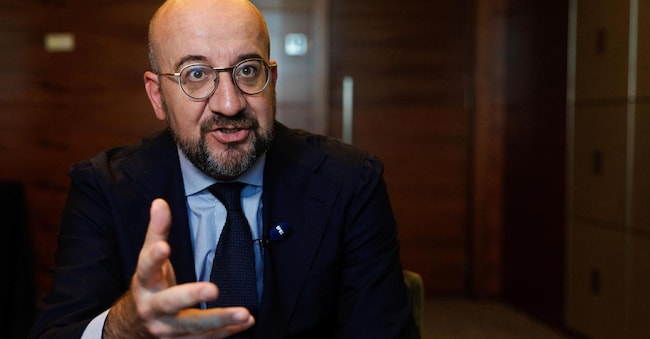
The coming weeks will not only be devoted to analysing the election results or to appointing new European leaders. The Twenty-Seven will also be called upon to approve a new Strategic Agenda, in fact the political programme of the next legislature. In a conversation with several newspapers, including Il Sole 24 Ore, European Council President Charles Michel outlined its three pillars yesterday: democratic principles, economic competitiveness, and security and defence.

Regarding the latter, the former Belgian prime minister noted a renewed 'common political will' on the part of the heads of state and government to tackle the issue together. "Even countries that were reluctant in the past, hesitant, are absolutely of the opinion today that we need more investment, less fragmentation, more European capacities". He added: 'There is the political will to align our means with our ambitions'.

Loading...

Financing and joint debt

On the contentious issue of defence funding, the 48-year-old European Council President noted a willingness on the part of governments to look at the issue 'with open eyes'. Among other things, the politician noted how Denmark, a country traditionally reluctant to go down the road of joint borrowing, had been more open. He added that the new strategic agenda must challenge 'the various taboos'.

In an outline of the document to be approved on 27-28 June, there is talk of a 'new dedicated defence fund' with which to finance 'flagship projects at European level, including an air defence shield or new measures to strengthen cyber security'. In this regard, the former Belgian prime minister said he was convinced that the European Union was facing 'a paradigm shift'. He emphasised 'the political and intellectual progress made by the Twenty-Seven in this field'.

The opinion of our interlocutor is not trivial. Despite nationalistic impulses in many countries and differences of opinion on certain issues, the Union increasingly appears in the eyes of citizens as a safe haven, an island of stability, a bulwark against uncertainty. A survey by the Fondation pour l'innovation politique in Paris reveals that 57% of Europeans trust the Commission and Parliament more than their own government (44%) or parliament (51%).

In this context, "the negotiation on the future EU budget 2028-2034 will entail a serious discussion on the size" of the financial instrument, which today weighs in at just 1 per cent of gross domestic product, net of the NextGenerationEU, which was created in the wake of the pandemic. The President of the European Council also expressed his confidence that 'sooner or later' the member states will be called upon to increase the capital of the European Investment Bank (EIB).

The latest polls on voting

.

These stances come just days before the EU vote. The latest polls suggest an increase in votes for the more nationalist political forces. Barring any surprises, however, the centrist parties - popular, socialist and liberal - should continue to hold an absolute majority of seats in the new assembly: 398 out of the minimum 361, according to a survey published yesterday by the Institute for European Policymaking of Bocconi University.

It will probably "not be easy" to agree on future institutional positions, said Charles Michel, who is currently engaged in bilateral consultations. An initial informal meeting of heads of state and government will be held over dinner on 17 June, followed by a summit on 27-28 June. On the table will be the presidencies of the Commission, the Council, the Parliament, as well as the post of High Representative for Foreign and Security Policy.

Criticism of von der Leyen

Currently, the strongest candidate for the Commission presidency is the current president Ursula von der Leyen. Yesterday, the former Belgian prime minister indirectly criticised her for having played the 'geopolitical' executive card, a choice that would have made the institution 'less impartial', falling into 'double standards' and offering a backing 'to those who fight European integration'. At the same time, he pointed out that Article 17 of the Treaties lists the Commission's tasks precisely.

In this sense, the politician recalled Mrs von der Leyen's controversial choice to support Israel in October in the aftermath of the Hamas attack. "We then paid the price" in that part of the world, he added. Charles Michel's stance towards the Commission president seemed to reflect the desire of many member states to ensure more predictability in the next legislature, but also an enduring animosity between the two personalities.

Copyright reserved ©

Brand connect

Loading...

Newsletter

Notizie e approfondimenti sugli avvenimenti politici, economici e finanziari.

Iscriviti