Fact checking

EU Duties at 39%? Here's why the real numbers say otherwise

There has been much discussion about the 39% 'tariffs' that the EU would impose on the US, but the numbers say otherwise

by Annalisa Godi and Chiara Ricciolini

3' min read

3' min read

The EU would impose tariffs of up to 39% on its goods on the US. But how were these 'tariffs' calculated?

This is the percentage that President Donald Trump indicated when he announced from the Rose Garden of the White House on Wednesday afternoon, 2 April, the imposition of tariffs on the United States' trading partners.

Loading...

Waving a billboard that was struggling to stand still in the strong wind, he displayed the names of the countries subject to the new US-made tariffs. Next to the states appeared two columns.

The first represented the 'duties applied to the US, including currency manipulation and barriers to trade', the second the 'reciprocal lowered duties applied by the US'. According to this table, the EU would impose duties of 39% on US products. And in the face of these alleged European impositions, the US reciprocates by imposing a tariff of 'only' 20%, just over half.

"In reality, the tariffs applied by the EU to American products amount to 3%," explains Tommaso Monacelli, Professor of Economics at Bocconi University.
The all-Trumpian calculation of tariffs

.

According to the official document of the Office of United States Trade Representatives, entitled Reciprocal Tariff Calculations (https://ustr.gov/issue-areas/reciprocal-tariff-calculations), the 39% figure does not indicate the duties that Europe applies to the United States.

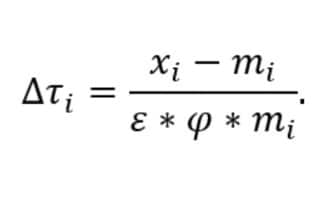
Instead, this is a theoretical estimate: it represents the average tariff that, according to the US administration's calculations, the United States would have to impose on its trading partners in order to wipe out the losses that the US would incur as a result of tariffs imposed by other countries.

"The 39% calculated by Trump measures the trade deficit of imported and exported products between the US and Europe," the professor clarifies. Within this percentage, the White House has also considered some items that have little to do with the idea of a duty or tax imposed on a good when it enters the US: health costs applied, for example, to the storage of foodstuffs to prevent them becoming vehicles for epidemics (sausages, cheese or other foods).

We are talking not about an actual figure, but about a modelling construction. The model uses official import and export data in 2024 from the US Census Bureau (https://www.census.gov/foreign-trade/Press-Release/ft900/ft900_2412.pdf) and is based on a formula that incorporates two key variables.

The first is epsilon, which indicates the elasticity of demand, i.e. a coefficient measuring how much consumers reduce their purchases if the price of a good increases. The second is phi, which represents the percentage of the duty that is actually passed on in the final price of the product; set in the document at 25%, meaning that a quarter of the duty would be reflected in the prices paid by consumers.

For example: the US imports olive oil from Italy and, due to duties, this good will cost more for American consumers. Epsilon wants to calculate the decrease in this demand. For Monacelli it is 'utopian to assume this value with precision, because it varies from good to good and in the long and short term'.

Furthermore, if one uses the formula used by the United States Trade Representative to calculate the variation of duties to reduce the trade deficit to zero for other states, one can determine what percentage Italy would be subject to if it were not part of the European Union: the variation amounts to 57%.

Since the Trump administration calculated the duties that would hit other countries by dividing the result given by the formula by two, duties of 29% would be imposed on Italian products. Nine percentage points more than those imposed on the European Union.

The difference between imports and exports in US-EU trade

"The basic idea is that if the United States has a trade deficit with Europe, it is because Europe has put up barriers to American products, i.e. duties that the European economy imposes on their products," the professor explains.

The American economy is in deficit to the rest of the world because it saves very little compared to what it invests, in fact the propensity to consume of Americans is higher than that of us Italians, for comparison, and the tendency to save of an American family is lower. The same goes for public savings, which will be even lower when Trump cuts taxes and increases the fiscal deficit.

"The US trade deficit is a sign of the strength of its economy, because everyone wants to invest in the US: it was considered a bit of a refuge for investors, for the dollar and government bonds. Now the opposite is happening,' Monacelli clarifies.

Copyright reserved ©
Loading...

Brand connect

Loading...

Newsletter

Notizie e approfondimenti sugli avvenimenti politici, economici e finanziari.

Iscriviti