
EU Enlargement: Balkans Summit kicks off, but Ukraine and Moldova are already in sight
On the table of the 27 are the dossiers of six countries: first to enter perhaps Montenegro, then Albania

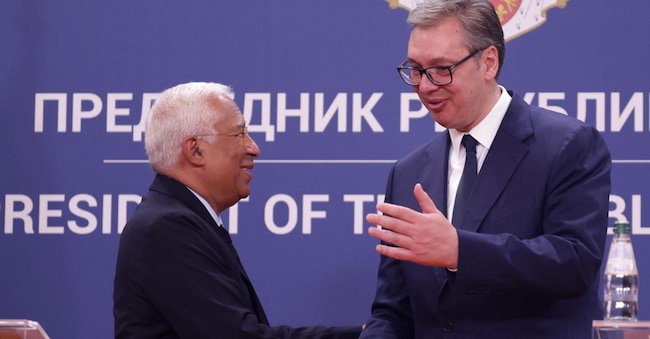
The EU-Western Balkans summit kicks off today in Tivat, Montenegro, putting on the table of the 27 the dossier of the enlargement of the Union to six countries: Albania, Montenegro, Serbia, Bosnia-Herzegovina, Kosovo and North Macedonia. The first to join, perhaps as early as 2028, should be Montenegro, which is hosting the summit, followed by Albania for which there is talk of 2030. The summit will be attended by most of the European leaders: from Giorgia Meloni to French President Emmanuel Macron, from German Chancellor Friedrich Merz to Spanish Prime Minister Pedro Sanchez, up to Cypriot Nikos Christodoulides, the EU's rotating president. Also present were all the leaders of the EU institutions: European Council President Antonio Costa, Commission President Ursula von der Leyen and Europarliament President Roberta Metsola.
Although today's summit is dedicated to the Balkans, Ukraine and Moldova will also be discussed at the table of the 27, after the Presidency of the European Council announced on Wednesday that the first step towards the start of accession negotiations had been taken at Coreper. The date for the formal opening of the first of the six so-called enlargement 'clusters' is expected to be set for 15 June in Luxembourg. Although all EU members were in favour of starting talks with Ukraine and Moldova, the dossier was unblocked by the new Hungary of Prime Minister Peter Magyar, who abandoned the hostile positions of his predecessor Viktor Orban and reached an agreement with Kiev on the rights of the Hungarian minority in Ukraine, which consists of around 100,000 people. A condition, this one, considered essential by Budapest to be able to support Ukraine's entry into the EU.
In the Balkans, despite the fact that the integration process has progressed in recent years, tensions have never completely subsided. Between Serbia and Montenegro, for example, the latest incident occurred just yesterday on the eve of the summit. The Belgrade intelligence services officially advised the Serbian president, Aleksandar Vucic, against going to Tivat because of alleged threats to his life. Among the reasons for tension cited is also the decision by the Montenegrin authorities to repatriate 87 Serbian citizens who landed in Tivat yesterday on a charter flight: the group is accused of being among the pro-government activists who attacked demonstrators in Belgrade during more than a year of street protests against Vucic. European Council President Antonio Costa himself, who made official visits to each of the six Balkan EU candidate countries in the days before the summit, reminded each that there are still steps to be taken before they can become full members. To Serbia, in particular, Costa reminded the need to speed up reforms concerning the rule of law and freedom of the press.
Instead, Costa asked Edi Rama, the Albanian prime minister whom he met on Tuesday, for more commitment against corruption and crime. After Montenegro, Albania remains to date the Balkan country furthest ahead in the accession negotiations. But street demonstrations in recent months have taken place in Belgrade as in Tirana, in this case in protest against a government that many of the Albanians now in opposition consider corrupt. In Albania, civil society has also taken to the streets in recent days against the maxi-building plans of Jared Kushner's company - the son-in-law of US President Donald Trump - which, with the endorsement of Prime Minister Rama, would like to build luxury resorts in a protected area of the country, that of the marine park around the island of Sazan.
Decidedly further down the road are Bosnia-Herzegovina and Kosovo. The former still lacks several reforms to start accession negotiations, the delay of which has already cost Sarajevo the loss of EUR 108 million in EU funds, in addition to putting another EUR 373 million at risk. As for Kosovo, which goes to elections on Sunday for the third time in a year and a half, political instability has already cost EUR 882 million in lost funding from the EUR 6 billion ceiling of the 2024-2027 European Fund for Reform and Growth for the Western Balkans.


