
EU funds: Foti proposes a task force to the regions lagging furthest behind in spending
Pnrr minister attacks: 'After elections still no content on files'

3' min read
Key points
3' min read
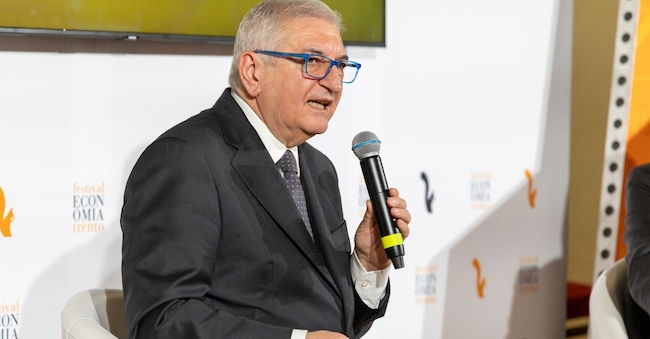
Eleven months have passed since the European elections, during which, however, 'only the headlines of the dossiers have been spoken about in Europe, whereas content is needed'. Tommaso Foti's assessment of his first six months as minister for European Affairs, the NRP and Cohesion is not a tender one: 'I have participated in five General Affairs Councils,' he sums up, 'and each time the same issues have been discussed without any decisions being taken. Even if urgencies loom, starting with what he calls the 'unfair competition' between areas of the world in the battle against climate change: 'Between 2021 and 2023, CO2 emissions were reduced by 31% in Europe and 21% in the US, but increased by 289% in China: how do you compete like that?
The remodelling of the Pnrr
.In his speech at the Trento Festival dell'Economia, interviewed by Tg1 director Gian Marco Chiocci, he takes stock of the NRP, with the technical remodelling that is needed to 'guarantee the implementation of all the works' and the general revision that is coming, but above all he asks Brussels for a change of pace without which even the Italian plan risks failing on important parts: 'Transition 5.0 is not working because European constraints require certification of the improvement in environmental performance compared to the previous five years, with analysis work that only large companies can sustain.
Accountancy Data on Structural Fund Expenditure
But there is not only the Pnrr. Foti's table is also cluttered with a substantial package of national and European cohesion funds waiting to be spent. And the figures are merciless: according to the latest monitoring bulletin just published by the General Accounting Office, at the end of February, out of 72.7 billion, only 3.7 billion (5.11%) had actually been spent, i.e. disbursed to beneficiary companies and local authorities. If by the end of the year the programmes of the regions (and especially of the ministries) do not reach the 7 billion mark, the difference will be lost: the automatic decommitment rule will be triggeredwhich means having to renounce the share of EU funding (European Regional Development Fund and European Social Fund plus) and the resources will go to other EU states. "This is not just an Italian problem," the minister put in his hands on the sidelines of his speech. And he consoles himself: 'The European average expenditure is around 7%. The expenditure of Italy, the second largest recipient country, is substantially in line with that of Poland, the only member state receiving more than Italy, while Spain is practically zero. 'For some programmes, actual expenditure is zero or almost zero,' stresses Foti. From the tables of the Ragioneria it is easy to see which programmes we are talking about: Basilicata, Molise, but also Sicily.
Ministry programmes even further behind
.But concerns also affect some national programmes, the two entrusted to the Ministry of Labour, Young Women and Work and Inclusion and the Fight against Poverty, remain at the starting tape, zero round. In general, the expenditure of the ten national programmes managed by the ministries or the Department for Cohesion lagged even more behind than that of the regions: the percentage of expenditure stands at 2.9 per cent. In some cases the overlap with the NRP, which, having a tighter timeframe for expenditure, has taken precedence over the Structural Funds, both in terms of projects and human resources, is more than evident. But now the knots are coming to the boil. 'Often the administrations lack the technical capacity to complete projects,' Foti explained, 'so we proposed to the programmes most in difficulty the technical assistance of a dedicated task force. I have convened and met with some of the lagging regions. Now we hope that with the mid-term review initiated by Commissioner Fitto something will be unblocked. More than defence spending, the regions are interested in the possibility of doubling the resources allocated to poor housing in the cities and in increasing pre-financing from the current 5 per cent to 30 per cent, a measure that also applies to investments in the water sector, which the regions are looking at very closely.


