
EU launches Industrial Accelerator Act, plan to strengthen European industry
Introduced the 'Made in Europe' criterion and fixed quotas for low-carbon products. New rules also for foreign investments

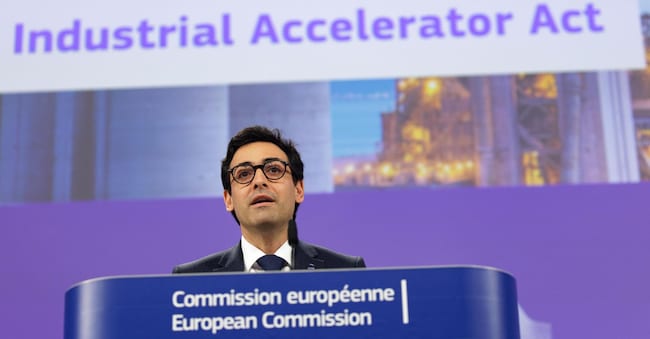
After several postponements, the European Commission proposes the Industrial Accelerator Act, a strategy for industry that sets 'Made in Europe' and 'low carbon emission' criteria for access to public procurement and subsidies. The aim is to ensure that manufacturing industry accounts for 20% of EU GDP by 2035.
The strategic sectors involved
The Commission's proposal comes in response to a geopolitical landscape characterised by the 'weaponisation' of economic dependencies and a reduction in the share of the manufacturing sector in the EU's GDP (down from 17.4% in 2000 to 14.3% in 2024). To reverse this trend and protect against dangerous dependencies, the regulation intervenes in some strategic sectors: energy-intensive industries (such as steel, cement, aluminium and chemicals), automotive and clean technologies.
Low-carbon materials
The Industrial Accelerator Act aims to introduce minimum quotas of low-carbon products of European origin in the construction and automotive sectors from January 2029. The quotas for low-emission materials are set at 25% for aluminium and 5% for cement. For steel, however, there will only be a minimum requirement of 25% low-carbon content.
The criterion of 'Made in Europe'
The new regulation introduces a preference for 'Made in Europe' in access to procurement and other forms of incentives. For clean technologies, the components to which this criterion applies are wind, batteries, solar photovoltaics, electrolysers, heat pumps and some nuclear components. As for automotive, preference will be given to electric cars entirely assembled in the EU, with at least 3 battery components and 70% of non-battery components manufactured in the EU. The same 'Made in Europe' criteria will be extended to non-EU countries ensuring reciprocal access to public procurement also for European companies. For other public interventions, such as public programmes and auctions, partners may be included in the light of a free trade agreement or customs union with the EU.
New rules for foreign investment
The regulation also introduces limits for foreign direct investment exceeding EUR 100 million in strategic emerging sectors (batteries, electric vehicles, solar, critical raw materials) if the investor's country holds more than 40 per cent of global production capacity. Under the new proposal, the Commission only authorises foreign investments that meet at least four of the following six conditions a 49% cap on foreign capital; a requirement to operate through a joint venture with European companies; the transfer of know-how; a EU labour force share of at least 50%; an expenditure on research and development in the Union of at least 1% of annual turnover; and finally a commitment to source at least 30% of the inputs used for products placed on the European market from the EU.

