Migration crisis

Migrants, EU: ‘Early warning systems to be activated following the Ceuta incident’

Spanish Minister of the Interior: 70,000 have returned from Ceuta to Morocco. Criticism of Italy’s decision to suspend the Schengen Agreement. The death toll in the waters off the enclave on the Spanish border has risen to 75

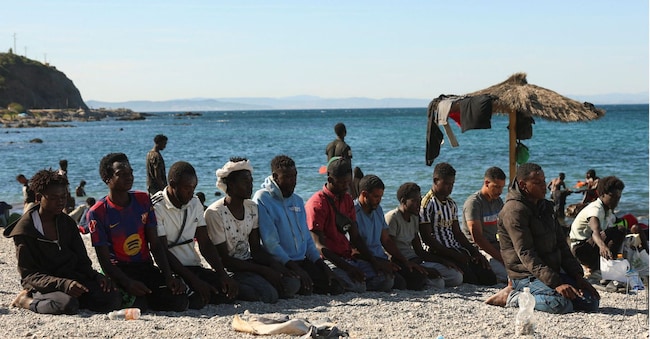
I migranti pregano mentre attendono su una spiaggia di Ceuta, in Spagna, a seguito delle traversate di massa con esiti mortali compiute da migranti a piedi e via mare dal Marocco verso il territorio spagnolo, il 3 agosto 2026. REUTERS/Violeta Santos Moura REUTERS

6' min read

Translated by AI
Versione italiana

6' min read

Translated by AI
Versione italiana

During the video call between EU interior ministers on the Ceuta crisis ‘a shared vision emerged on the need to continue fighting migrant smuggling relentlessly, to step up returns, to strengthen the EU’s borders, to establish solid partnerships with third countries and to improve forecasting capabilities’. This was announced by the Council of the EU, which added: “The ministers emphasised that communication should be more coordinated and more consistent, particularly to counter malicious external actors engaged in the manipulation of information and foreign interference.”

Death toll in the Ceuta migration crisis rises to 75

Meanwhile, the number of confirmed fatalities in the wave of migrants that swept through Ceuta last week has risen to 75. This was confirmed by the government delegation in the autonomous city, following the recovery yesterday of a further three bodies from the waters off the Spanish coast, bringing the total – and still provisional – death toll of migrants to 75. The local authorities in Ceuta had previously reported that 88 bodies had been recovered in the Iberian exclave. Meanwhile, on the Moroccan side, Rabat has reported at least 11 fatalities.

Loading...

Piantedosi: ‘Use every means at our disposal against those who do not cooperate’

“If a third country refuses to cooperate on the readmission of its own citizens, the Union must be able to apply strict conditions across all sectors, using all the levers at its disposal.” This was stated by Interior Minister Matteo Piantedosi in his address to the extraordinary Justice and Home Affairs Council. “We can no longer allow economic diplomacy to run on a separate track from cooperation on security and migration.”

“Italia has formally requested this, both in a letter addressed to Commissioner Brunner and at the last Informal Council meeting in Dublin, with regard to countries such as Morocco, which, despite not cooperating on returns, enjoys significant advantages in its trade relations with Europe,” the minister emphasised. “In this regard, we warmly welcome the change brought about by the new Generalised System of Preferences Regulation, recently approved by the European Parliament and set to come into force on 1 January 2027,” he added. “Alongside a firm stance on borders and the fight against people-smuggling networks, Europe must have the courage to resolutely pursue innovative solutions.”

Brunner: “No migrants from Ceuta have entered the Schengen area.” But “I understand Italia’s position; people were worried”

“There was full solidarity with Spain around the table. The meeting was also a very useful opportunity to clarify the situation on the ground. Spanish Minister Fernando Grande-Marlaska confirmed that the situation is under control, that no one has actually crossed onto Spanish mainland territory and that the Schengen area has not been affected.” This was stated by the EU Commissioner for Home Affairs, Magnus Brunner, at the press conference following the informal Council meeting on the Ceuta crisis; however, he also said he understood Italy’s position, as people were concerned.

“We need to assess” Italy’s decision to suspend the Schengen Agreement following the events in Ceuta, the Commissioner told reporters “Under the new Schengen Code, countries may, in exceptional and temporary circumstances, reintroduce border controls if they are facing an emergency that jeopardises their national security,” Mr Brunner explained.

EU: “Following Ceuta, early warning systems and social media monitoring to be activated”

Speaking to the press, Brunner pointed out that one of the five points in the roadmap announced yesterday by President von der Leyen in her letter to Prime Minister Sánchez “concerns the implementation of early-warning systems. We must strengthen our capacity to monitor trends in disinformation, for example on social media, by working closely with Europol and all other EU agencies”. “The fifth point of this plan concerns the dismantling of people-smuggling networks. We must urgently adopt a comprehensive sanctions regime against migrant traffickers’. Another point ‘concerns the further strengthening of our external borders. This means bolstering border support, both on the ground and in third countries. We are currently preparing a new mandate for Frontex, which will be adopted after the summer recess. It also means vigilant monitoring, and we also need physical infrastructure at critical points,” he added.

EU Commissioner: Six EU countries are working on hubs for repatriation to third countries

Six Member States of the European Union are working together to initiate discussions with third countries on the creation of return hubs. Following the informal meeting of interior ministers on the migration crisis in Ceuta, EU Commissioner Brunner explained that ‘return hubs were mentioned by some Member States, particularly those that are preparing facilities of this kind or are about to begin negotiations with third countries’.

The Commissioner distinguished these initiatives from the agreement between Rome and Tirana. “The Italia-Albania project is different: it is an Italian project. But, as you know, five Member States – now six – are working together to discuss with third countries the creation of repatriation hubs.” For Brunner, this “is legitimate and is the responsibility of those Member States that wish to do so”. At the same time, according to the Commissioner, work also needs to be done on the concept of a ‘safe third country’, “under which the asylum procedure can be carried out outside the European Union”. “Member States must also make better use of tools such as the new ‘safe third country’ concept, which allows asylum procedures to be carried out outside the European Union, in a safe third country and in accordance with specific rules. This, too, is important for further discouraging irregular migration,’ the European Commissioner emphasised.

Brunner: no links to Ceuta, but regularisations are not a good sign

“We do not currently see a direct link between the regularisations and the events in Ceuta,” added Brunner at the press conference following the informal Home Affairs Council meeting held via videoconference on the Ceuta crisis, in response to a question about Spain’s plan to regularise migrants. Regularisations, Brunner explained, “are not a good signal for the rest of Europe – absolutely not. I understand that this is a matter for national authorities and that these measures were taken because the migrants are mainly from Latin America – they speak the same language and share the same culture – but the message for the rest of Europe is not a positive one. Not at all.”

Loading...

Spanish Minister of the Interior: 70,000 have returned from Ceuta to Morocco

Since the start of the crisis in Ceuta, “72,000 migrants have entered illegally. Of these, 70,000 have returned to Morocco.” This was stated by the Spanish Minister of the Interior, Fernando Grande-Marlaska, at a press conference following the EU ministers’ video conference on migration.

At the meeting with European interior ministers, “it was made clear that Ceuta enjoys special status within the Schengen area” and that “no one can leave Ceuta without their documents being properly checked”, Grande-Marlaska explained.

Grande-Marlaska described the ‘recognition’ given during the meeting to the work carried out by Spain in this ‘unprecedented humanitarian crisis’ as ‘satisfactory’.

Spanish minister criticises Italy’s decision

However, the Spanish minister criticised Italia’s stance on the issue: ‘What I said in my opening remarks was that I did not understand why these internal checks – albeit exceptional – had been put in place for travellers arriving in Italy by sea or air from Spain. I did not understand this for several reasons. Firstly, because Spain has never lifted the checks. Secondly, because there was no risk, for the reasons explained, of any kind of secondary movement, given that Ceuta has a special status and no one leaves Ceuta without having been checked. Thirdly, because today Frontex, the agency, and all those involved have stated that the Schengen area was in no way at risk.’

“I also mentioned,” continued Grande-Marlaska, “that we have recently seen secondary movements coming from the east and heading for Spain. They are not entering via the Mediterranean, but from the east, as I have already said, and we have no internal border controls. For all these reasons, I stated that it seemed to me to be completely pointless and disproportionate for Italia to have acted in this way,” emphasised Grande-Marlaska, referring to Italia’s decision to temporarily suspend the Schengen Agreement and to reinstate checks on those arriving by sea or air from Spain.

Marlaska: Spain voted against centres in third countries

‘As regards centres in third countries, I must point out that this is nothing new. Spain has already made this clear at meetings of the EU Council of Ministers of the Interior: “We voted against it for the reasons already explained. So this is not a new development, and it certainly was not a key issue at today’s Council of Ministers meeting, which focused primarily on what should have been the main focus: the crisis in Ceuta,” added Spanish Interior Minister Fernando Grande-Marlaska.

Denmark: ‘Very satisfied’ with Spain’s response regarding Ceuta

Denmark has said it is “very satisfied” with Spain’s response to the crisis triggered by the arrival of thousands of migrants from Morocco in the Spanish autonomous city of Ceuta.

“I am very pleased that Spain has acted swiftly, particularly by deploying the police and the army, and that many migrants have already returned to Morocco,” said the Minister for Immigration and Integration, Morten Bodskov, in a statement issued at the end of the EU summit. “However,” he added, “these events demonstrate that it is absolutely essential to have control over the EU’s borders.”

Copyright reserved ©
Loading...

Brand connect

Loading...

Newsletter

Notizie e approfondimenti sugli avvenimenti politici, economici e finanziari.

Iscriviti