
Energy margins from EU of around 6.8 billion, double in 3 years
Sources: EU energy flexibility worth 0.3% GDP by derogation 1.5% for defence. Italian request to tackle high energy prices partly accepted

Key points
OK for 'some' flexibility on energy spending, but only with regard to investments. This would be the orientation of the EU Commission after extensive evaluations in Brussels in order to give a signal already on Wednesday 3 June, within the spring package of the European Semester, to the demand for measures against the high energy costs put forward by Italia.
Partly accepted Italian request to tackle high energy prices
The expectation from leaks in Brussels is that flexibility will be opened up for investments in energy within the safeguard clause derogating the Pact for investments in defence. In short, Italy's request to tackle the high cost of energy would be partly accepted, with the focus, however, on opening up to investments and not subsidies.
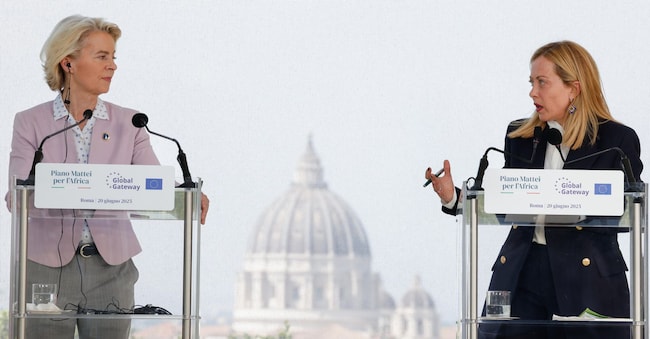
EU: no formal written response to Meloni's letter
At the moment, as we understand it, the European Commission does not envisage a formal written response to the letter sent in recent days by the Italian prime minister on the derogation to the energy pact. The response, as announced in recent days, will in fact consist of the package - and the flexibility under the defence safeguard clause - envisaged for the European Semester.
Energy margins from EU of around 6.8 billion, double in 3 years
A fiscal flexibility margin of about 6.8 billion per year, within the annual derogation of 1.5 per cent of GDP provided by the defence safeguard clause. This is the Commission's response to Italia's request to extend the defence pact derogation to energy spending as well. According to sources close to the dossier, the Berlaymont Palace would have provided for structural expenditure in the energy sector a margin of flexibility equal to 0.3% per year over the three-year period of 2026-28, but with a ceiling of 0.6%. This means a range of between EUR 6.5 and 7 billion, or 0.3% of Italy's GDP, and up to EUR 13-13.5 billion (or 0.6%, according to current GDP estimates). This is not an additional derogation to the safeguard clause envisaged for defence, but a space of flexibility granted within the perimeter of 1.5% of GDP per year granted, from 2025 and for four years, to the 27 on expenditure related precisely to military spending.

