
EU, Zuppi: 'The challenge is to choose dialogue for peace and not rearmament'
The president of the Italian bishops tackles the binomial of war and peace, choosing the key of humanity as a category that precedes politics, interprets it and offers keys to solving problems

3' min read
3' min read
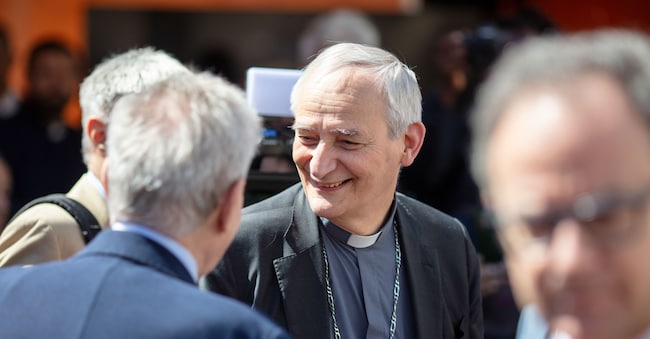
"I see no other alternative. Each of us must first gather in ourselves and then destroy in ourselves what we wish to destroy in others". Cardinal Matteo Zuppi quotes Hetty Hillesum, Dutch writer and victim of the Shoah, to represent the spiritual effort that must be made to overcome war and prepare for peace. Everywhere and at all times. "Hetty Hillesum wrote this about how she felt towards her Nazi executioners as she prepared to die in the concentration camp. This spiritual rebirth in pain constitutes a great human and inner test. In particular, it becomes so now that war and death have once again become elements of our reality, as well as of our imagination and memory,' says the archbishop of Bologna.
The dialogue with essayist Marco Magnani, an economist lent a brilliant conductor at the Trento Festival of Economics, is close and lively. At the Teatro Sociale, Zuppi speaks at the end of a particularly intense month: "The election of Pope Prevost, which was very rapid and well assisted by the Holy Spirit, has shown how the Church has no governance problems," notes the cardinal, winking at an audience composed, also, of entrepreneurs, professionals and economists. Without exaggerating the seriousness: 'This month, in addition to the conclave, there was also the Coppa Italia won by Bologna. It didn't go badly,' he adds.
The president of the Italian bishops tackles the binomial of war and peace, choosing the key of humanity as a category that precedes politics, interprets it and offers keys to solving problems. Even when men take up arms. "Some time ago in a school,' said Zuppi, in a Social Theatre packed with young people, 'a boy asked me but when will man learn to live without killing. For a Guccini lover like me, it was good to answer him with Dylan, the answer is in the wind. War is back as a part of our everyday life. We need craftsmen of peace. But also architects of peace. Think how much the post-World War II coal and steel agreement contributed to the long period of peace for Europe. It defused tensions between Germany and France. And it delineated an institutional architecture for the subsequent European Union that experienced an extraordinarily long and prosperous period of peace. There is, also, an anthropological hard core that goes with all this. New inner attitudes towards others are needed: think of St Francis saving the wolf from the inhabitants of Gubbio, who wanted to kill him, because he tamed him by addressing him as Fra Lupo. A combination of elements is needed. A new inner attitude towards the other is needed. And precisely architects of peace are needed. It was important that, in the scenario of war between Russia and Ukraine, Pope Leo XIV declared his willingness to mediate'.
On a morning spent at the Trento Festival of Economics, after his dialogue with Magnani, Zuppi moved on to discuss economy and the common good with the president of Confcooperative, Maurizio Gardini. 'The challenge for your world,' Zuppi stressed, 'is very strong. If we reflect on the connection that exists between the development of cooperation and Catholic mutuality in the last century and the publication of Pope Leo XIII's Rerum Novarum, it becomes a great stimulus to think that the new pontiff chose the name Leo XIV and immediately placed the emphasis on artificial intelligence. A century ago there was the industrial revolution. Now this extreme form of digital revolution is underway. In the transition from 'I' to 'we' and in the transformation of profit into the common good, the experience of cooperatives is fundamental'.


